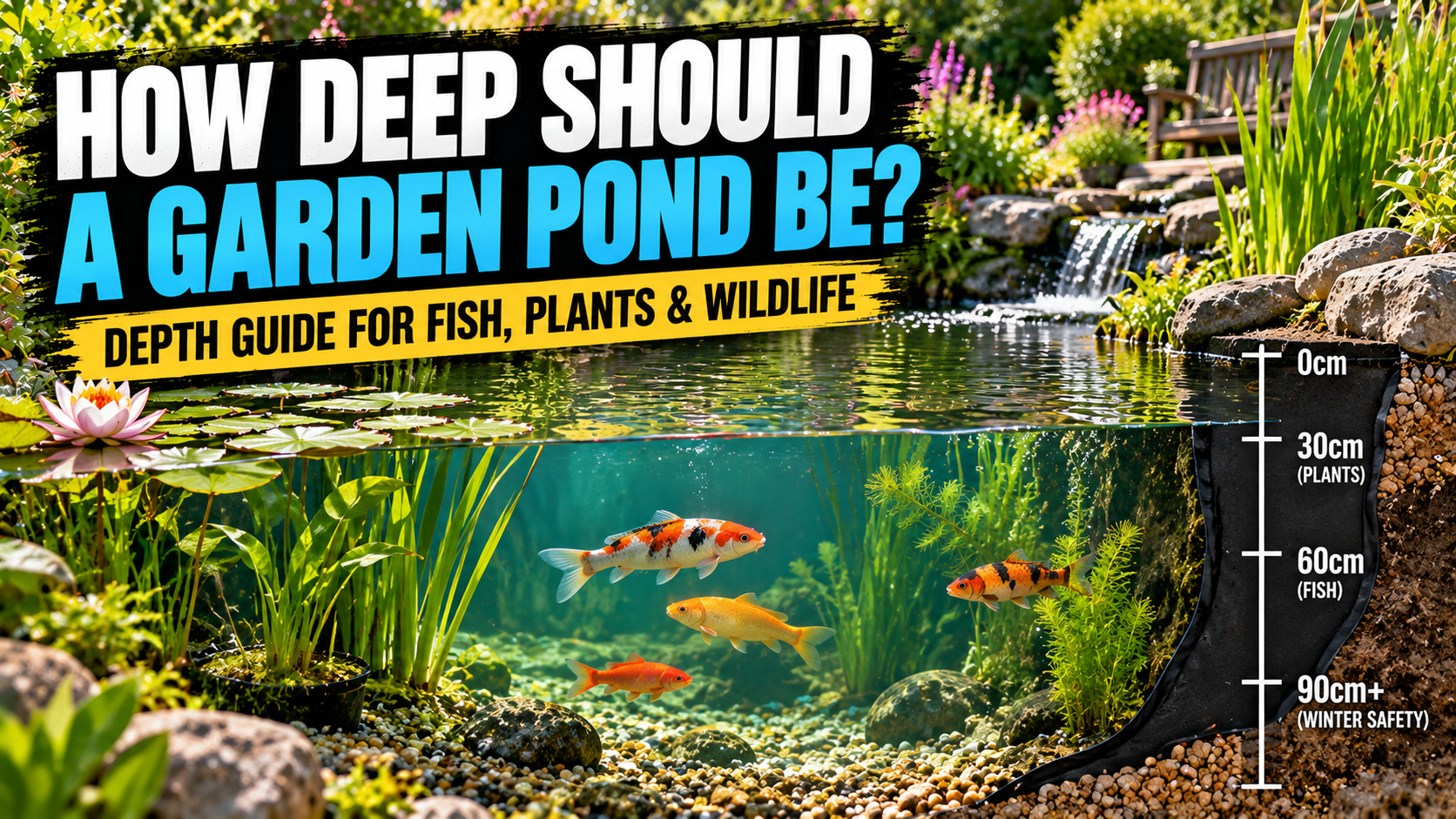
Deciding how deep to make a garden pond is one of the most important design choices you’ll make. Depth affects what plants can grow, whether wildlife will use the pond, how well fish will survive winters and hot spells, and what equipment you will need. This guide explains sensible depth ranges for wildlife, ornamental and fish ponds, why shelves and slopes matter, and the practical steps to build and maintain a healthy pond.
Quick answer
How deep should your pond be?
There is no single correct depth for every pond — it depends on the pond’s purpose.
Broad guidance used by UK pond professionals and conservation bodies is: wildlife ponds are typically shallow, with the deepest areas around 20–30 cm; small ornamental ponds are generally at least about 40 cm deep; fish ponds should be deeper — some sources give a minimum around 38 cm and others recommend 60 cm or more for a better winter refuge and a wider planting range. Koi need substantially deeper and larger ponds and should be treated as a specialist project.
These numbers are ranges, not hard rules. The key is matching depth to use, creating a mix of shallow and deeper zones, and providing the right filtration and aeration where fish are kept.
Why depth matters
What pond depth affects — ecology, safety and wintering
Depth influences several practical and ecological factors. Deeper water provides a winter refuge where bottom water stays warmer, but deep water alone doesn’t guarantee enough oxygen—circulation and aeration matter where fish are present. Very shallow water supports high invertebrate diversity and is favoured by many amphibians and aquatic insects.
Surface-area-to-depth ratio also matters. A small, very deep pond can be more prone to deoxygenation because it has limited surface area for gas exchange relative to volume. If you want a deep central refuge, increase surface area or plan appropriate aeration and filtration to support fish.
Finally, steep-sided deep ponds are poor for wildlife. Gentle slopes, shelves and a variety of depths create habitat diversity and make the pond safer and more useful for plants, invertebrates and amphibians.
Design tip
Build shelves and zones — the most important single design step
A successful pond usually has several depth zones: very shallow margins and scrapes for invertebrate and amphibian spawning, mid-depth shelves for marginal plants, and a deeper central area if you want to keep fish. Very shallow areas (around or below 10 cm) can be particularly productive for wildlife; mid shelves at planting depths will suit many marginal species.
Include at least one long, gentle slope or a built ramp so wildlife can access and escape the water. If your aim is to grow a wide range of plants, follow established planting-depth guidance — our page on how deep to plant pond plants explains common planting zones and examples.
For wildlife
Shallow, varied ponds are best for wildlife — keep fish out where possible
If the main aim is to encourage wildlife, design the pond to be shallow and varied. Conservation guidance typically recommends a maximum depth of 20–30 cm; many invertebrates and some amphibians favour very shallow water and the margins.
Introducing fish to a wildlife pond reduces its value for invertebrates and amphibians because fish eat pond insects, tadpoles and spawn. If you want both wildlife and fish, consider separate ponds or clearly separated zones.
A wildlife pond should be left largely undisturbed once established — avoid adding soil or turf to the basin, and do not feed wildlife ponds. Keep a mosaic of shallow shelves, marginal planting and open water to maximise biodiversity.
For garden fish
Ponds for goldfish and garden fish need deeper refuges and equipment
Ponds intended for garden fish are best built with a deeper central refuge and plenty of shallow planting shelves. Many UK horticultural sources recommend a minimum pond depth of around 38 cm for fish, while other guidance suggests 60 cm or more to give a reliable winter refuge and room for different plants and fish behaviours.
Fish ponds also require appropriate filtration and often aeration or circulation to maintain water quality and oxygen levels—especially if stocking levels are higher. If you keep fish, plan space for a filter and pump and ensure easy access for maintenance. Read more on whether you need a filter and how to choose the right one before you commit to stocking.
Useful links: Do I Need a Pond Filter?, How to Choose the Right Pond Filter, What Size Pond Pump Do I Need?
Koi advice
Koi need specialist ponds — think big, deep and bespoke
Koi are large, active fish that need substantially more water volume, depth and high-performance filtration than small garden ponds. Because koi produce more waste and need more space to behave naturally, don't add them to a small or shallow pond. They also need the right pond shape, access for equipment, and regular husbandry.
If you are considering koi, treat the project as a specialist build — consult koi-keeping guidance, manufacturers and experienced pond builders rather than relying on general small-pond rules. Do not assume a standard garden pond will be suitable.
Practical build
Liner, edges, access and safety — practical points to plan now
When digging and lining a pond, plan where you will put pumps, filters and pipe runs. External filters benefit from space for maintenance; avoid exposing liners to sunlight where equipment will sit. One side of the pond should have a gentle slope or ramp — this helps wildlife and reduces ice pressure on the liner in winter.
Edge treatments matter: rocks, planting and a planted marginal shelf make the pond safer and more natural-looking. Be mindful of leaf fall in autumn; a heavy leaf load will increase maintenance and nutrient enrichment, so rake off large quantities before they sink to the bottom.
Install and use electrical equipment according to the manufacturer's instructions. Do not improvise wiring; use proper outdoor-rated cables, follow safety guidance, or hire a qualified installer if you are unsure.
Common problems
Depth-related problems (and how to avoid them)
Several common problems relate to pond depth. Small but very deep ponds can suffer oxygen shortages; avoid this by increasing surface area, adding circulation or reducing stocking. Shallow, nutrient-rich ponds warm up quickly and can encourage algal blooms. Using rainwater to fill or top up where possible reduces nutrient inputs compared with untreated mains water.
If the pond water turns green, the issue may be microscopic algae or nutrient overload — our guide explains causes and steps to clear green water. For aeration and pump running times, see our pages on whether to run a pump 24 hours a day and how much electricity pumps use before changing your pump schedule.
Helpful links: Why Is My Pond Water Green?, How to Clear Green Pond Water, Should You Run a Pond Pump 24 Hours a Day?, How Much Electricity Does a Pond Pump Use?
Before you dig
Quick checklist to choose depth and design your pond
Before you start digging, answer these questions:
What is the primary purpose — wildlife, ornamental or fish? Depth follows purpose.
Will you keep any fish? If yes, plan a deeper central refuge plus filtration and aeration.
How much space can you give the pond? A larger surface area improves oxygen exchange at any depth.
Can you collect rainwater for filling and topping up to limit nutrient inputs?
Where will you place a filter and pump, and will you have easy access for maintenance?
Do you need planting shelves for the plants you want to grow? See planting-depth guidance.
Use our calculators to estimate pond volume, liner size and equipment needs before you buy: Pond Volume Calculator, Pond Liner Calculator, Pond Pump Calculator, Pond Filter Calculator.