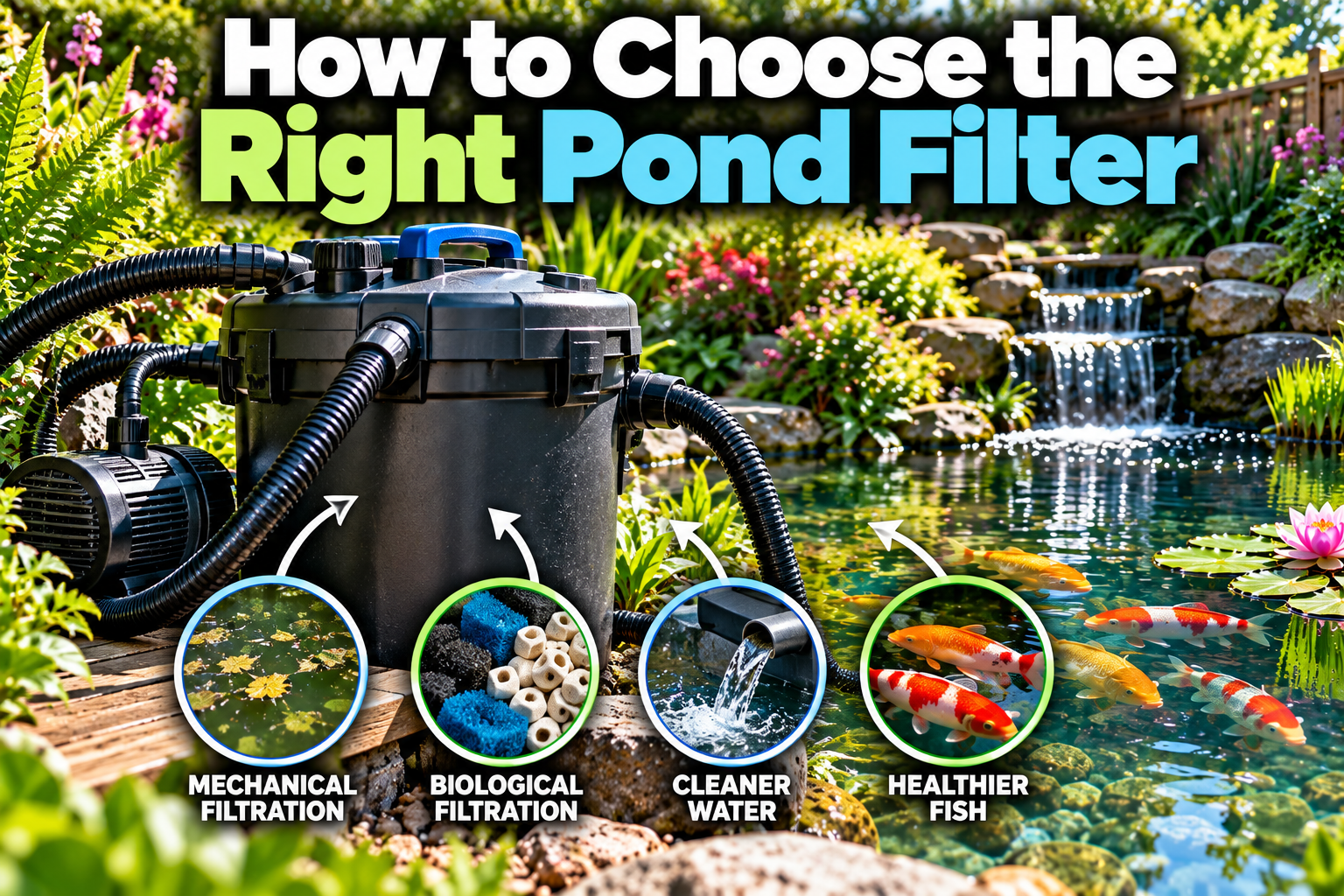
A pond filter has two main jobs: remove solids (uneaten food, faeces, plant debris) and provide surface area for beneficial bacteria to process fish waste. Not every pond needs one — wildlife ponds and lightly stocked ornamental ponds often do better without heavy filtration. For garden ponds with significant fish numbers, an appropriately chosen filter helps keep water clearer and reduces waste that can harm fish. This article explains when a filter is needed, what different filters do, how to match a filter to your pond and stock, and the safety and maintenance points to consider.
Need or not?
When does a pond actually need a filter?
Start by asking what lives in your pond and what you want from it. A filter is generally needed when a pond carries a substantial fish population: fish produce solids and nitrogenous waste that mechanical and biological filtration help manage. By contrast, wildlife ponds and low‑stock ornamental ponds often rely on plants, mixed depths and natural processes rather than mechanical filtration.
If your primary aim is to support amphibians, aquatic insects and wild plants, adding fish and a filter tends to increase nutrient inputs and can reduce biodiversity. If you do want a pumped feature (for example a cascade or fountain) for wildlife reasons, fit intake protection so animals and tadpoles cannot be drawn into equipment.
What it must do
Filtration functions: mechanical, biological and clarifying
Filters perform three distinct roles. Mechanical filtration traps and removes solid material such as uneaten food and faeces so it does not accumulate in the pond; this effect is immediate when the filter is running. Biological filtration provides surface area for nitrifying bacteria that convert ammonia to less harmful products; these bacteria take around six weeks to establish and can be severely reduced or die if a biological filter is shut down for about 24 hours, so don’t rely on it until it has matured.
Separately, ultraviolet (UVC) clarifiers are not mechanical or biological filters: they expose passing water to UV light so suspended algae clump together and can then be removed by the mechanical stage. UVCs are typically installed ahead of the main filter to improve clarity and filtration efficiency, but they do not remove solids or dissolved nutrients on their own.
Types explained
Common filter types and where they’re best used
Internal in‑pond filters are compact, usually foam‑based units that sit in the water. They suit small ornamental ponds and light fish loads and are relatively easy to install; many can be run intermittently.
External pump‑fed or pressure filters sit beside the pond and allow larger volumes of media in stages — useful where space allows and for medium ponds with moderate fish loads. Gravity‑fed or flow‑through filters are installed at pond level or sunk into the bank so water returns by gravity; these systems offer larger media volumes and are commonly used on bigger ponds and koi systems.
Drum filters and automatic self‑cleaning units are aimed at high‑demand installations such as large koi ponds and swim ponds where automated solids removal reduces manual cleaning, but they are not maintenance‑free and require correct sizing and servicing. Skimmers and surface filters remove floating debris before it sinks, reducing the organic load reaching the main filter. Some all‑in‑one units combine mechanical media, biological chambers and UVC clarification — convenient for garden ponds, but always check the manufacturer’s guidance for suitability with your fish species.
Sizing principles
How to match a filter to your pond and stock
Pond volume is the starting point for choosing filtration: calculate average length × average width × average depth to get cubic metres, then convert to litres (multiply m³ by 1,000). If you prefer a tool, use our Pond Volume Calculator to work it out precisely.
Once you know the volume, adjust for fish numbers and type. Heavily stocked ponds and koi produce far more solids and need larger mechanical and biological capacity than lightly stocked ornamental fish ponds. Also consider your water feature: waterfalls and long runs may suit gravity return setups and will affect pump and siting choices. If you are unsure how stocking or pond design increases workload, discuss options with a reputable supplier and rely on manufacturer specifications rather than general rules of thumb.
Finally, check access to electricity and place equipment where it can be safely serviced and protected from frost. Any new electrical work should be installed by a qualified electrician.
UVC — what it can and can’t do
When a UV clarifier helps — and when it won’t
A UVC clarifier can be effective at reducing green water caused by free‑floating algae because it causes the algae to clump so the mechanical filter can remove it. However, UVCs do not remove debris or dissolved nutrients and are only as effective as their installation and maintenance allow: they need the correct flow conditions, a clean unit and periodic bulb replacement.
If you’re trying to fix chronic algae issues, a UVC used alongside proper mechanical and biological filtration and measures to reduce nutrient input is the sensible approach. For more on their effectiveness see Do UV Clarifiers Work for Green Pond Water?
Safety first
Installation and electrical safety
Electrical safety is critical around water. Have any permanent power supplies, sockets or external installations done by a qualified electrician who understands outdoor and pond safety requirements. Place pumps and filters where they are easy to access for maintenance and, where possible, in frost‑protected positions or insulated housings to avoid damage in winter.
For pumps and intakes, fit guards or pre‑screens to reduce risk to wildlife. Follow manufacturer instructions for plumbing and avoid DIY electrical work; an unsafe installation can endanger people, pets and wildlife and may invalidate warranties.
Upkeep matters
Maintenance, common mistakes and troubleshooting
All filters need regular attention. Mechanical media must be cleared of trapped solids so they do not overload the biological stage; UVC bulbs and electrical parts require periodic replacement and checks; and automated systems need manufacturer servicing to remain effective. A common mistake is undersizing filtration for the fish load, or expecting biological filtration to work immediately — those beneficial bacteria need time to colonise and can be harmed if the filter is left idle for extended periods.
Other pitfalls include running filters intermittently without considering bacterial survival, and transferring water or pond life from other ponds (which risks introducing disease or invasive species). If algae or other problems persist despite a correctly sized and maintained filter, investigate environmental drivers such as stocking levels, feeding rates, sunlight and planting cover rather than simply upsizing equipment.
Beyond the filter
Non‑filter steps that reduce workload and improve water
Filtration is only one tool. Reducing nutrient inputs and encouraging balanced plant cover are often more effective long‑term than relying on equipment alone. Marginal planting, submerged oxygenators and providing some shade reduce sunlight and nutrient availability for algae. If green water is an issue, see Why Is My Pond Water Green? and How to Clear Green Pond Water; if you’re unsure whether you have blanket weed or green water, our comparison Green Pond Water vs Blanket Weed can help.
When topping up or changing water, think about the quality of the source. For guidance on using tap water safely in a pond, consult Can You Use Tap Water in a Pond?
Next steps
Choosing a product and getting help
When you’re ready to buy, use pond volume and stocking information to compare manufacturer specifications rather than relying on labels alone. For high‑demand ponds such as koi systems, look for scalable or modular solutions (for example a skimmer + mechanical pre‑filter + large biofilter, or drum/self‑cleaning units where appropriate) and read the fine print on maintenance and warranty. Rely on manufacturer sizing figures and flow‑rate data for selection; if uncertain, ask a reputable supplier or pond professional for a site visit.
If problems continue after installing appropriate filtration and a sensible management routine, consult a pond specialist who can assess design, catchment inputs and stocking levels rather than just recommending bigger equipment.