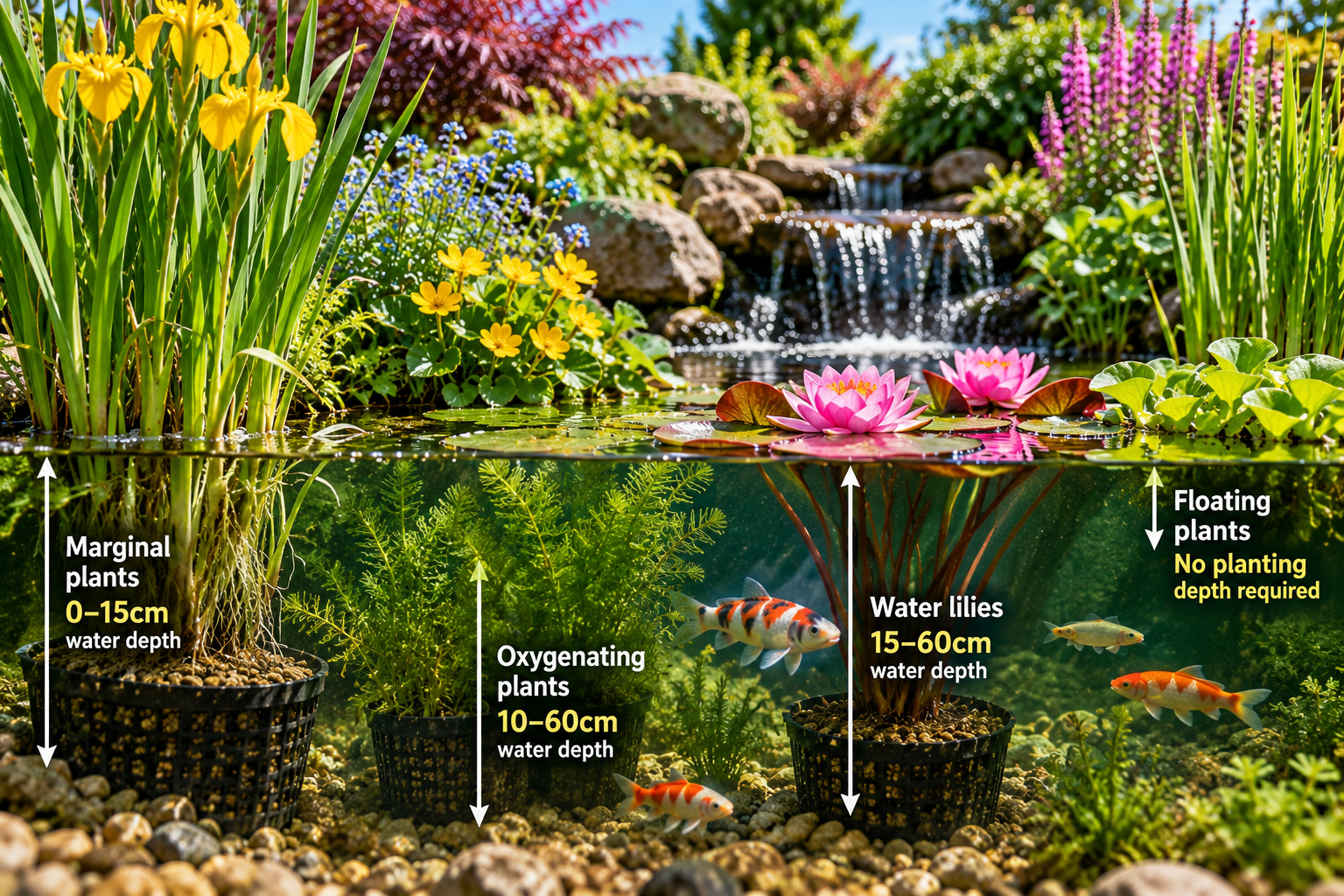
No single depth suits every pond plant. Different species need anything from a few millimetres of water at the bank to over a metre for some deep-water waterlilies. How deep you dig and where you place plants also depends on whether you want a wildlife pond, an ornamental garden pond, a fish pond or a koi system. This guide explains common depth bands, practical planting rules you can follow, and the consequences of going too shallow or too deep.
Quick answer
Depth depends on the plant and the pond's purpose
There isn’t a single correct depth for pond plants. Instead, use depth bands and choose planting positions that match each plant’s needs. Shallow margins suit many emergent and invertebrate-friendly species; mid-depth shelves suit taller marginals and young waterlilies; deep zones suit adult submerged plants and large waterlily cultivars. Your pond type (wildlife, ornamental, fish or koi) affects how much deep water you should include.
Read on for practical depth bands, waterlily ranges, planting technique and how to avoid common problems such as nutrient pulses or oxygen shortfalls.
Depth bands
Standard planting zones: drawdown, fringe, mid-depth and deep
Pond designers commonly use four depth bands. These help you place the right plants in the right spot and create a varied habitat.
• Drawdown/splash zone: exposed seasonally; mud and germination zone for wetland plants. Useful for species that tolerate drying out part of the year.
• Fringe / very shallow: a few millimetres up to about 1–10 cm of water. Supports emergent seedlings, young shoots and many invertebrates.
• Mid-depth / marginal-to-emergent rooting zone: commonly around 10–30 cm. Good for taller marginal plants and some young submerged or floating species.
• Deeper / deep water: 30 cm and deeper. Many deep-water species and adult submerged plants require this depth; some waterlily cultivars need substantially more (see the waterlily section below).
Placing shelves and gentle slopes that include these bands gives you the widest range of planting choices and better habitat value.
Pond purpose
How planting depth changes for wildlife, ornamental, fish and koi ponds
Think about what you want from the pond before fixing depths.
Wildlife ponds: Freshwater Habitats Trust (FHT) recommends lots of shallow water and suggests that the deepest areas should be no more than about 25–30 cm for wildlife-only ponds. They also advise aiming for roughly 50% shallows and including a drawdown zone and gentle shelving to support diverse plants and invertebrates. The RHS takes a wider view for mixed-use ponds, suggesting a range of about 20–60 cm will suit most pond flora and fauna — the two organisations therefore give different practical limits depending on whether you intend a wildlife-only pond or one that also supports fish.
Ornamental garden ponds: Shelved planting areas are commonly used. RHS recommends marking a marginal shelf about 30 cm wide when constructing. Oase suggests at least around 40 cm at the deepest point for a small garden pond so you can grow a wider variety of plants and create visual interest.
Fish ponds: Advice varies. RHS gives a general minimum construction depth of 38 cm and, in other guidance, recommends 60 cm as a safer minimum where fish are present to reduce freezing risk. FHT notes the common practice of digging to about 50–60 cm for fish ponds. Deeper pockets give fish refuge from temperature extremes but also change maintenance and equipment needs.
Koi ponds: Industry and winter-care guidance from manufacturers and RHS typically advise keeping ponds at least about 60 cm deep for fish welfare and overwintering. If you plan koi, treat depth as one part of a system that also requires appropriate filtration and aeration.
Practical planting
How to plant: containers, rhizomes, gravel caps and quarantine
Follow a few simple rules when planting to avoid nutrient pollution and give plants the best start.
• Plant to the same depth as in the original container. Container-grown pond plants are usually best left at that depth when you move them to the pond. For deep-water species, you can lower their containers gradually as the leaves reach the surface.
• Rhizomatous plants (for example, some irises and cannas) should have the rhizome positioned just above the soil surface rather than buried deeply.
• Use baskets or containers for marginals and vigorous species to control spread. Cap compost with a thin layer of gravel so fish can’t stir up the planting compost and release nutrients.
• Quarantine new plants for a few weeks before adding them to the pond to reduce the chance of introducing invasive species, pests and hitchhikers.
And importantly: do not add garden turf or general garden soil directly into the pond; this introduces a large nutrient pulse and can cause long-term water quality problems.
Waterlilies
Waterlily depth ranges and planting tips
Waterlilies have well-defined depth needs. RHS gives the following planting ranges for cultivars:
• Miniature/very shallow cultivars: water 10–30 cm (4 in–1 ft).
• Small/medium cultivars: ~30–45 cm (1–1½ ft).
• Medium/large cultivars: ~45–75 cm (1½–2½ ft).
• Large/deep cultivars (some Nymphaea): 75 cm–1.2 m (2½–4 ft).
Always check the label or supplier guidance for the specific cultivar you buy. Plant waterlilies in heavy aquatic compost inside baskets and cap with gravel; lower the basket gradually if you’re bringing new plants into deeper water so the crown isn’t suddenly placed too deep.
Oxygenators and fish
Submerged oxygenators: benefits, limits and safe planting density
Submerged plants (oxygenators) help with water clarity and provide oxygen during the day, but they respire at night. RHS gives a practical guideline of roughly 4–5 bunches (about 3–4 stems per bunch) of oxygenating plants per square metre to avoid over-supplying vegetation.
Too many dense submerged plants can contribute to night-time oxygen dips, particularly in warm weather or in ponds with high levels of organic matter. Balance oxygenators with open water and other planting. RHS also recommends aiming for about half the pond surface covered in foliage overall to provide shade and reduce algal growth.
See our guide to the best oxygenating plants for details on species suited to UK ponds: /guides/best-oxygenating-plants-uk-pond
Equipment & depth
Deeper ponds mean different equipment and management
As depth and fish stocking increase, so do equipment and management needs. Heavily stocked fish and koi systems usually require mechanical and biological filtration and often UV clarification for suspended algae. Manufacturers such as Oase recommend placing UVC clarifiers upstream of filters in many setups, but you should follow the manufacturer’s sizing and installation guidance and consult a qualified installer for electrical work.
Freshwater Habitats Trust points out that deep ponds need enough surface area relative to depth to avoid oxygen problems; they advise surface area roughly 5–10× the maximum depth if you choose to dig deep. If you plan a deep, fish-stocked pond, factor in appropriate filtration, aeration and maintenance—see our introduction to filters: /equipment/do-i-need-a-pond-filter and consider pump running costs: /equipment/how-much-electricity-pond-pump-uses.
When to plant
Timing, water source and seasonal considerations
RHS suggests mid-spring to early summer as the best time to plant many pond species because the water and air are warming and plants will establish quickly. FHT notes many native marginals and floating species are robust and can be added at other times, but quarantine new material first.
Use collected rainwater where possible. Tap water often contains nutrients and chemicals that can encourage algae; treat it or let it stand, according to product guidance, before introducing plants and fish. Wait a few weeks after filling a new pond before adding fish so the environment stabilises, but you can add many plants earlier to help establish biological balance.
Design tips
Shelves, safety and common pitfalls to avoid
If you’re creating or re-profiling a pond, include a range of shelf widths and depths. RHS recommends a marginal shelf about 30 cm (1 ft) wide—wide enough for a range of marginal species and easier planting and maintenance. Gentle slopes and a drawdown zone make the pond wildlife-friendly and reduce steep drop-offs that can be a hazard.
Watch these common mistakes: putting garden turf or soil in the pond; over-planting oxygenators; failing to provide any shallow water for invertebrates and amphibians; and assuming a single depth suits every plant. Plan shelves to suit the species you want (use our plant guides to choose species by type: /guides/best-marginal-pond-plants-uk, /guides/best-floating-pond-plants-uk, /guides/best-pond-plants-uk).
Finally, if you’re unsure about depths for specific plants, check the individual plant or cultivar label and follow supplier guidance — particularly for waterlilies and larger marginal species.