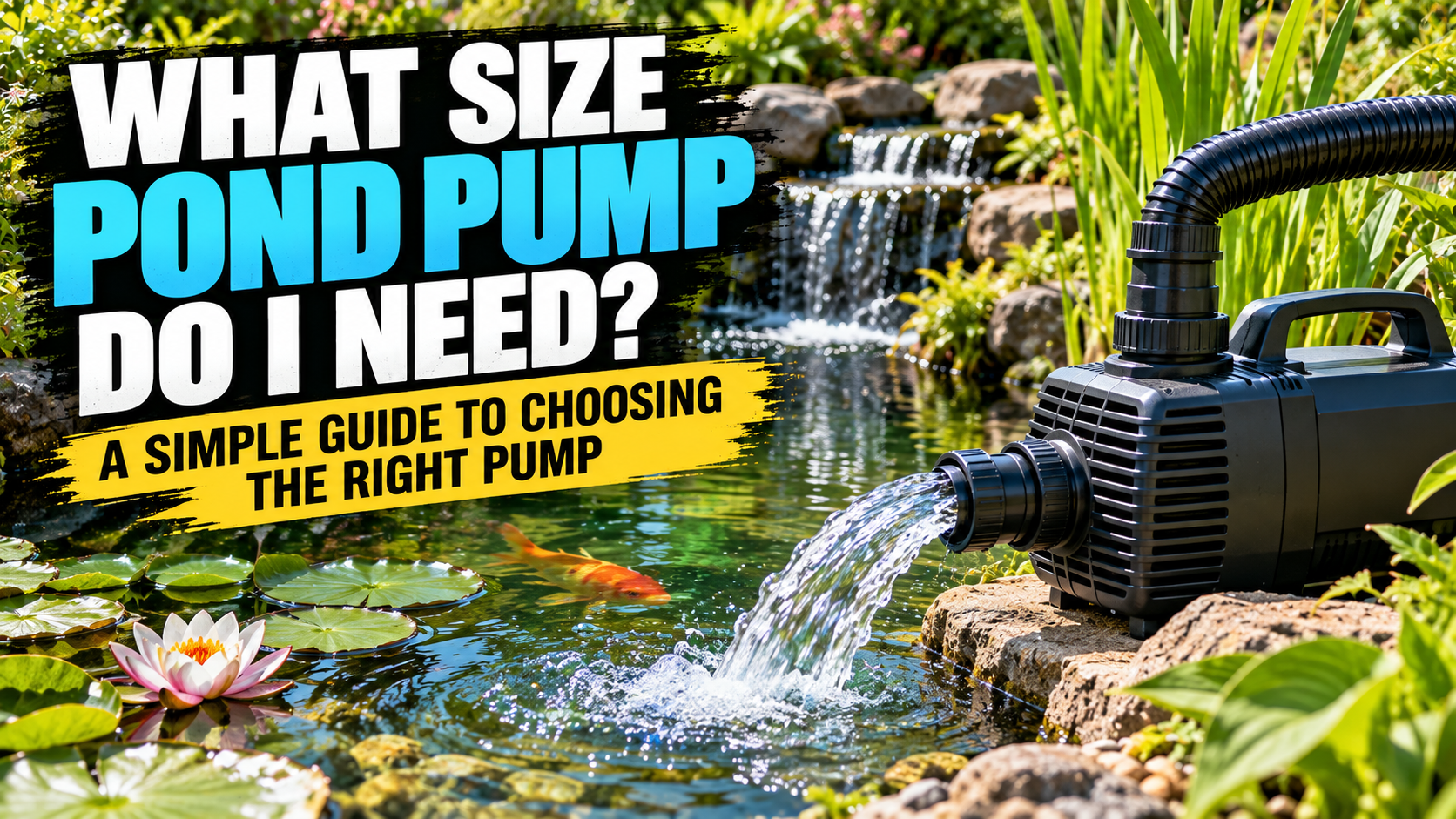
Picking a pump is one of the most practical jobs for any pond owner — get it right and your pond will circulate, filter and feed features efficiently; get it wrong and the pump will struggle, cost more to run and may shorten equipment life. This guide explains the three things you must know — pond volume, desired flow and Total Dynamic Head (TDH) — then walks through sizing, plumbing and maintenance in plain English. There are links to tools and guides if you want to run the numbers yourself.
Quick answer
Three measurements decide pump size
The right pump delivers the flow you need at the actual head (height and plumbing losses) in your system. In practice, you must know:
the pond volume (litres),
the required flow (turnover for circulation/filtration or the flow needed for a waterfall/feature), and
the Total Dynamic Head (TDH) — the vertical lift plus friction losses in the pipework.
As a rule of thumb used for garden ponds, circulating roughly half the pond volume every hour can help reduce many types of algae — but turnover needs vary with pond type, fish load and features, so use that figure as a starting point rather than a universal rule.
Step 1
Calculate your pond volume
Start with an accurate pond volume: average length × average width × average depth gives cubic metres; multiply by 1,000 to get litres. For irregular shapes, take a few depth readings and use the average depth.
If you prefer a calculator, use the PondStuff pond volume tool to avoid mistakes: /tools/pond-volume-calculator
Knowing the volume is essential because both filter and circulation flow requirements are normally stated in litres per hour (l/h) or cubic metres per hour.
Step 2
Decide what you want the pump to do
Pumps serve three main purposes, and the size you need depends on which applies:
Circulation/oxygenation — even surface movement can help reduce duckweed and floating algae; Freshwater Habitats Trust notes that a garden pond pump which circulates about 50% of the water per hour can be effective against many algal species.
Filtration — if you fit a mechanical/biological filter, the pump must supply the filter at the manufacturer’s recommended flow. The Royal Horticultural Society notes that ponds with thriving fish populations will likely need a filter and pump.
Features (waterfalls/streams) — flows are chosen for appearance. Size waterfalls and streams by the visual flow you want, and ensure pumps deliver that flow at the feature's actual head.
Choose the primary purpose first — a heavy fish load usually means filtration takes priority; an ornamental pond aiming to reduce algae may favour surface circulation.
Step 3
Calculate Total Dynamic Head (TDH)
TDH is the figure manufacturers use on pump charts. In plain terms, TDH = Vertical head + Friction head.
Vertical head is the vertical distance from the pond water surface (or the pump intake level) to the highest point the water must reach (top of a waterfall, filter inlet, or discharge). For UK readers, measure this in metres, but be aware many manufacturer charts use feet — check units when you consult pump curves.
Friction head is the pressure lost as water moves through pipework and fittings. It depends on pipe diameter, material, flow rate, length and the number of bends. Narrow pipe and lots of elbows increase friction considerably; using a larger-diameter pipe reduces friction and usually improves pump performance and life.
Manufacturers provide friction-loss tables and pump curves to convert your vertical head and pipework into a TDH figure — consult those when you pick a pump. For more on measuring head height and why it matters, see our head-height guide: /equipment/pond-pump-head-height-explained
Step 4
Match the required flow at your TDH to a pump curve
Pumps are rated by flow against head — look at a pump’s performance curve (manufacturer chart) and find the flow that corresponds to your TDH. Choose a pump that delivers at least the flow you need at that head, and ideally operates near its best-efficiency point rather than at the curve's extremes.
If you’re sizing for a feature, first choose the visual flow you want (many manufacturers give recommended flows per unit width for waterfalls) and then find a pump that supplies that flow at the feature’s TDH. Our waterfall guide covers this in more detail: /equipment/choose-pond-pump-waterfall
If this sounds technical, an online pond pump calculator can do the heavy lifting once you have volume, desired flow and head: /tools/pond-pump-calculator
Worked example
A simple sizing example to follow
Example pond: 4.0m long × 2.0m wide with an average depth of 0.75m. Volume = 4.0 × 2.0 × 0.75 = 6.0m³ or 6,000 litres.
If you want to circulate roughly 50% per hour (a common starting point to help control algae), you would aim for about 3,000 litres per hour (3,000 l/h).
Next, measure vertical head — for example, if the pump sits at water level and the top of the waterfall is 1.5m above that, vertical head = 1.5m. Add friction head for the chosen pipe run; consult a friction-loss table or use an online calculator to convert pipe length, diameter, and flow into metres of head.
With required flow (3,000 l/h) and TDH (vertical + friction), use pump curves or the pond pump calculator to find a pump that provides 3,000 l/h at your TDH. If the chosen pump’s curve shows much higher flow at that TDH, it will work, but avoid running a pump continuously at the extremes of its curve.
Practical plumbing
Pipe size, fittings and where people often go wrong
Plumbing choices influence the pump almost as much as the pump itself. Key points:
Use the largest reasonable pipe diameter you can — a larger pipe greatly reduces friction losses and can let a pump deliver more flow for the same energy use.
Avoid unnecessary bends, sharp elbows and restrictive fittings; each adds to friction head.
Multiple smaller pipes in parallel often give more friction loss than a single larger pipe carrying the same total flow.
Keep inlet pipework short and generous. Problems frequently arise from undersized or long, twisting inlet runs that starve the pump.
Good plumbing extends pump life, reduces running costs and makes the system quieter and more reliable.
Pumps, filters and fish
Match pump, filter and fish load — and think about maintenance
If your pond contains fish, particularly goldfish or koi, the filter system is central. The pump must supply the filter at the flow rate the filter manufacturer recommends. Filters remove solids (mechanical) and establish beneficial bacteria (biological); the RHS emphasises that a thriving fish population usually needs a proper filter and pump.
Also consider UVC clarifiers if your main problem is green water — but they must be matched to the pump flow. Never assume a pump alone will solve water-quality problems: stocking level, plants and maintenance matter just as much.
Regular maintenance (cleaning filters, checking UVCs and inspecting pipework) keeps pumps operating efficiently. Poor maintenance, incorrect sizing or blocked filters are common causes of pump failure and water-quality issues.
Safety and when to get help
Electrical safety, specialists and koi systems
A qualified electrician should carry out any electrical work for a pond pump. Correct earthing, RCD/GFCI protection and safe wiring reduce risk to people and wildlife.
If you keep heavy-stock koi or plan a large gravity-fed filtration system, consider consulting a specialist dealer or pond installer. Koi ponds need robust, correctly sized pumps and filters; manufacturers and specialists can help you select models and calculate piping and TDH precisely.
Also keep in mind that incorrectly sized pumps and plumbing can shorten pump life and, in extreme cases in fish ponds, contribute to fish stress or losses—another good reason to use expert advice for large or heavily stocked ponds.
Next steps
Tools, further reading and sensible decisions
Collect three numbers (volume, desired flow, TDH), then use a pump curve or the pond pump calculator to choose models that meet your needs. Our pump and flow guides explain the next steps in more detail: /equipment/pond-pump-flow-rate-explained and /equipment/pond-pump-head-height-explained
If you’re unsure about friction calculations or matching a pump to a specific filter or feature, run the numbers with the PondStuff pump calculator or speak to a specialist dealer — they can check pump curves, plumbing and electrical requirements for you: /tools/pond-pump-calculator
Finally, balance your equipment choices with sensible maintenance and the type of pond you want: wildlife ponds often need little or no pumped circulation, whereas fish and koi ponds generally need continuous, well-sized filtration and a reliable pump.
PONDSTUFF PICKS
Recommended Pond Products
Products relevant to this guide that may help with the job.

POPOSOAP 20W Solar Pond Pump 320GPH Dry-Run Protection Quiet Pump for Pond
PondStuff may earn a commission from qualifying purchases at no additional cost to you. Prices and availability can change. Read our affiliate disclosure.