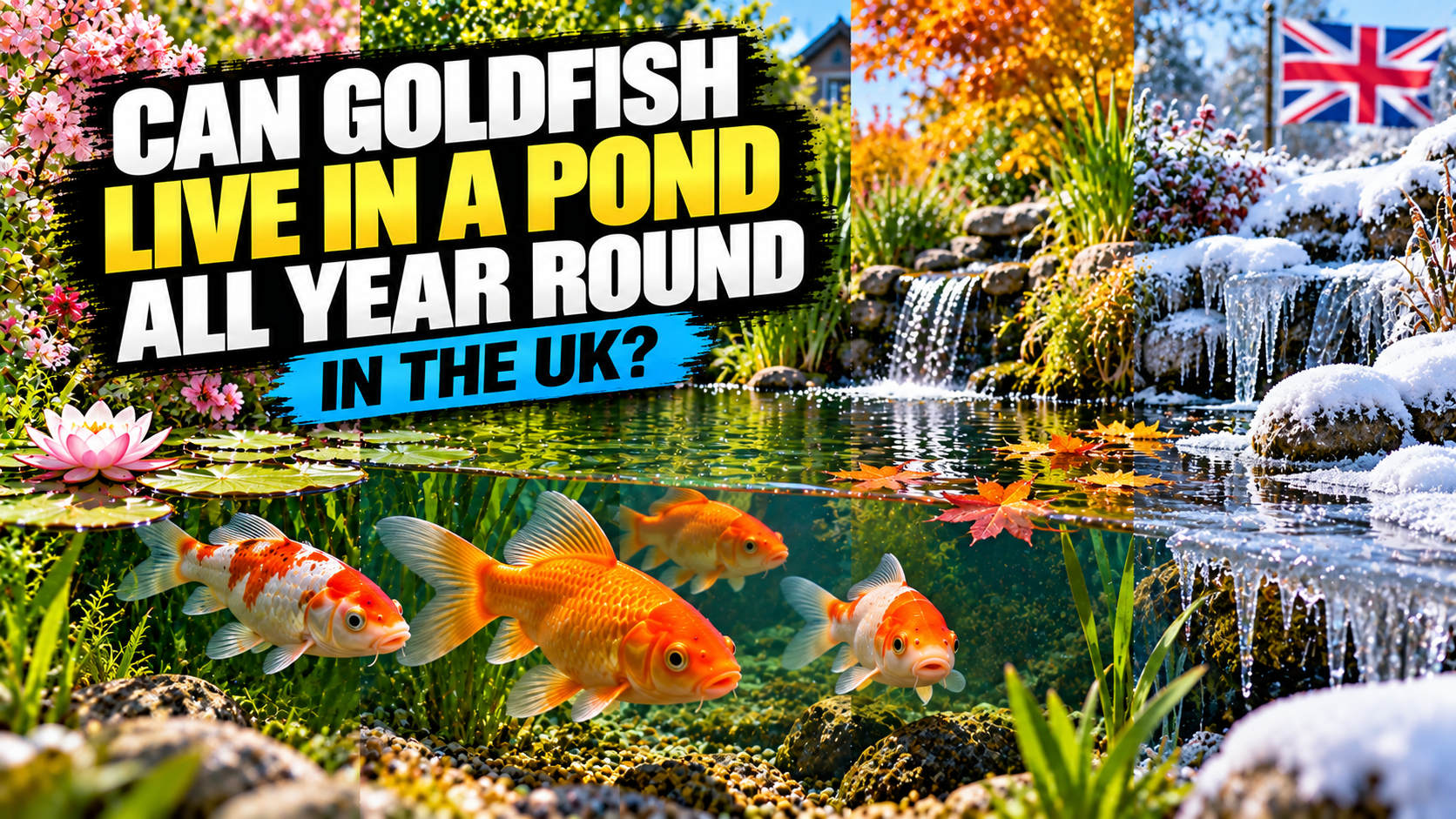
Many UK pond owners ask whether goldfish can stay outdoors through winter. The short answer is yes: goldfish commonly survive year‑round in ornamental garden ponds if the pond is designed and managed for winter. The key points are a suitably deep, undisturbed refuge, reliable oxygen or de‑icing provision, careful winter feeding, and sensible equipment winterising. This guide explains what to do (and what to avoid), and highlights important differences between ornamental fish ponds and wildlife ponds.
Short answer
Yes — but only with the right pond and winter care
Goldfish are commonly kept outdoors year-round in UK garden ponds. However, survival depends on pond design, winter management and the pond’s purpose. An ornamental or fish pond that provides a winter refuge and oxygen exchange can support goldfish through cold months; a wildlife pond should generally remain fish‑free.
Later sections cover specific measures: depth and shelter, oxygen and ice management, winter feeding, equipment care, and legal or conservation issues.
Pond type matters
Ornamental/fish ponds versus wildlife ponds
Decide first whether your pond is intended for keeping fish or for wildlife. Conservation bodies discourage stocking wildlife ponds with non‑native fish species such as goldfish because they can eat frogspawn, uproot plants, stir up silt, and increase nutrient levels that harm biodiversity.
If your pond is an ornamental fish pond with no connection to rivers or other water bodies, you can keep goldfish, provided you follow the care points in this guide. If your pond is designed primarily for wildlife, avoid adding goldfish — and never release garden fish into rivers, streams or wild ponds without the relevant Environment Agency consent.
Design and depth
Give goldfish a deep, undisturbed winter refuge
One of the most important design features for year‑round survival is depth. Pond professionals recommend a deep ‘refuge’ where cold surface water and ice do not mix with the bottom layer. A depth of at least around 60 cm (about 2 ft) is commonly suggested as a minimum for creating this refuge in UK conditions.
Position any pumps or aeration so they do not disturb that deep zone in winter (see equipment section). Also include submerged planting and other structures so fish have places to shelter. If you want more on general depth and pond profiles, see our guide on How deep should a garden pond be?.
Oxygen & ice
Keep a breathing hole — manage oxygen and surface ice safely
When ponds freeze over, oxygen exchange with the air can be restricted. The aim is to keep a small area of surface water open so gases can escape and oxygen can enter. Three common approaches include a pond aerator or air stone placed on a shelf above the deep refuge, a small pump positioned to keep a breathing hole without mixing the deep zone, or a purpose‑made de‑icer.
Crucially, do not place aeration equipment in the deep refuge — mixing warmer bottom water with cold surface water removes the safe refuge fish need. Never smash or bang ice; shock waves can injure or kill fish. If you must make a hole in ice, use warm water or carefully remove ice without striking the sheet.
For more on improving dissolved oxygen at other times of year, our guide on How to Oxygenate a Pond: 7 Ways to Increase Oxygen Levels is useful, and if you see fish gasping at the surface our article on Why Are My Pond Fish Gasping at the Surface? explains likely causes.
Feeding in winter
Feed carefully — stop when water gets cold
Goldfish are cold‑blooded: their metabolism slows as water temperature falls. Feeding when water is too cold leads to uneaten food and slowed digestion, which can cause health problems. Guidance from pond equipment specialists varies on exact temperature thresholds; the practical rule is to use water temperature rather than air temperature, be conservative, and stop feeding once the pond is regularly in the low teens °C.
Resume feeding only when water temperatures are consistently warm, and fish are clearly active. If you are unsure, it is safer to withhold food than risk leaving feed that will rot and foul the water.
Equipment care
Winterise pumps, filters and any UVC equipment
Filters, pumps and UV clarifiers can be vulnerable to frost. Where manufacturers label units as frost‑protected, follow their instructions; move frost‑protected pumps to a mid-shelf before severe frost and remove non‑frost‑proof pumps, filters and UVC units for storage before the first hard frost. Oase advises storing non‑frost‑proof units in a frost‑free place (for example, in water where the manufacturer recommends this) — follow the product manual.
Check or replace UVC bulbs annually, following manufacturer guidance. Follow product manuals for safe removal, handling and reinstallation — do not improvise. Our pages on pond pumps and filters can help you choose equipment and understand running requirements; see Do pond pumps need to run 24 hours a day? and How Often Should You Clean a Pond Filter?.
Stocking & water quality
Match fish numbers to pond size and keep water clean
A crowded pond creates higher waste loads and greater risk in winter—more fish mean more oxygen demand, more nutrients, and more silt disturbance. Conservation guidance warns against overstocking and against adding non‑native fish to wildlife ponds for these reasons. The appropriate number of goldfish depends on pond volume, depth, plant cover and filtration, so avoid generic ‘fish‑per‑litre’ rules without specialist advice.
Before winter, remove fallen leaves and excessive organic debris; topping up with rainwater where available reduces the need for treated tap water. If you want to check pond capacity for stocking or equipment sizing, the Pond Volume Calculator may help you estimate water volume to inform further decisions.
Health and disease
Reduce stress — do not try to diagnose disease from vague signs
Fish weakened by cold are more susceptible to parasites and disease, and problems sometimes appear when temperatures rise again. The best prevention is to reduce stress: preserve the deep refuge, avoid sudden temperature or oxygen changes, feed only when appropriate and keep water as clean as practical.
If you suspect disease, avoid guessing at causes or dosing chemicals without expert advice. Consult a vet with aquatics experience or an experienced pond specialist for diagnosis and treatment recommendations. Do not use medicines or pond chemicals without following the manufacturer's instructions and professional guidance.
Legal and conservation
Do not release goldfish into the wild — it’s harmful and may be illegal
Goldfish are non‑native in the UK and can become invasive in wild waterways. Releasing or allowing goldfish to escape into streams, rivers, lakes or wildlife ponds can damage native wildlife and is prohibited without Environment Agency consent. If you find non‑native fish in a wildlife pond or nearby waterbody, contact the appropriate conservation or environment authority for advice rather than attempting to move them yourself.
If you keep goldfish in a garden pond, make sure the pond has no uncontrolled connection to other waterbodies and take precautions to prevent accidental escapes during maintenance or flooding.
Practical checklist
Winter checklist — key actions to keep goldfish safe
Use this practical checklist when preparing for winter:
Provide a deep refuge (guidance suggests around 60 cm or more) so fish can shelter away from ice.
Plan a safe method to keep a small area of the surface ice‑free (aerator, de‑icer or carefully placed pump) without mixing the deep refuge.
Stop feeding once water temperature regularly falls into the low teens °C; resume only when fish are active, and water is consistently warm.
Store non‑frost‑proof pumps, filters and UVC units before hard frost and follow manufacturer guidance for frost‑protected equipment.
Clear leaves and excessive organic debris before freeze‑up and top up with rainwater if available.
Never smash ice and do not release fish into wild waterbodies.
When in doubt, take the conservative route: limit interventions that might stress fish and seek specialist advice for complex problems such as mass disease, heavy stocking or connected watercourses.