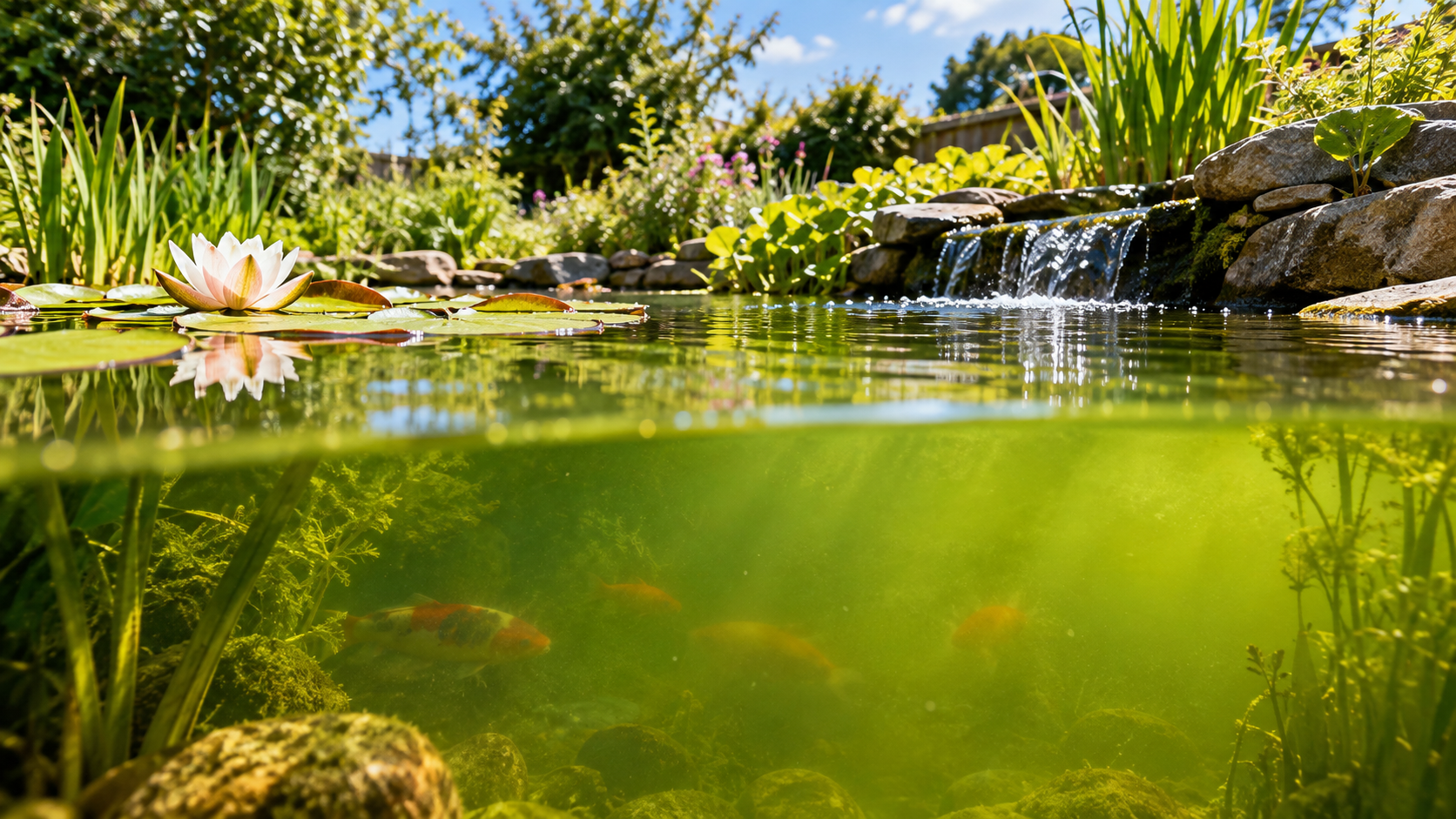
You look at the pond one morning, and instead of seeing the bottom, the plants, or even the fish, you're staring into something that looks like pea soup.
Green pond water is one of the most common problems pond owners encounter, particularly during warmer, brighter parts of the year. The good news is that green water does not automatically mean your pond has failed or needs to be emptied and started again.
The colour usually comes from large numbers of microscopic algae suspended in the water. Understanding why those algae have suddenly multiplied is far more useful than trying to clear the water as quickly as possible.
THE BASICS
What actually makes pond water turn green?
The familiar green colour usually comes from microscopic, free-floating algae suspended throughout the pond water.
These are different from the long, stringy growth commonly called blanket weed. You can pull or twirl blanket weed from a pond because it forms visible strands. The algae responsible for green water are suspended in the water itself.
A pond naturally contains algae. In fact, algae are part of a pond ecosystem, and you don't need to eliminate a small amount.
Problems begin when conditions allow algae to reproduce rapidly enough to dominate the water.
Sunlight is one important part of the equation. Like plants, algae use light for photosynthesis. A pond exposed to plenty of sunshine can therefore provide favourable conditions for algal growth.
Nutrients are another major factor. Water with elevated nutrient levels can provide algae with exactly what they need to multiply.
That means the real question isn't simply “How do I kill the algae?”
It is:
“What is allowing so much algae to grow in my pond?”
NUTRIENTS
Where do the extra nutrients come from?
Nutrients can enter or build up in a garden pond from several sources.
Fish waste can contribute nutrients, particularly in heavily stocked ornamental ponds. Uneaten fish food and decomposing organic material can add to the load too.
Leaves, dead plant material and other debris that fall into the pond eventually break down. Soil and nutrient-rich growing media entering the water can have a similar effect.
Even the water used to fill or top up a pond matters.
For wildlife ponds, rainwater is generally preferable where practical because tap water can contain nutrients that encourage algae and duckweed. Collecting rainwater in a water butt gives pond owners a useful source for topping up during dry periods.
This doesn’t mean a single leaf or occasional top-up will instantly turn a pond green. Pond ecology is more complicated than that.
It does mean that reducing unnecessary nutrient inputs is one of the most sensible long-term approaches to algae management.
NEW PONDS
Is green water normal in a new pond?
It can be.
A newly created pond hasn't yet developed the established plant growth and biological community of an older pond.
In spring in particular, pond water can suddenly turn green as algae respond to more light and warmer conditions. This can sometimes be temporary.
That is why reaching immediately for treatments isn't always the best first move.
Give plants time to establish, avoid introducing unnecessary nutrients and watch how the pond develops.
A wildlife pond, especially, doesn't need to look like a swimming pool to be successful. Crystal-clear water is not, by itself, proof of a healthy ecosystem.
FIRST STEPS
What should you do when your pond turns green?
Start by looking at the pond as a whole rather than treating the colour as an isolated problem.
Ask a few simple questions.
Does the pond get strong sunlight for most of the day?
Are there enough established aquatic plants?
Has a large amount of leaf litter or other organic material accumulated?
Are fish being overfed?
Is the pond heavily stocked with fish?
Could soil, fertiliser or nutrient-rich runoff be entering the water?
Has the pond only recently been created?
Those answers can tell you far more than the water colour alone.
Remove excessive dead organic material where practical, reduce unnecessary feeding and prevent fertiliser, ordinary garden compost and nutrient-rich soil from entering the pond.
Aquatic planting can also help create a more balanced environment. Floating-leaved plants such as waterlilies can provide shade across part of the surface, reducing the amount of light reaching the water below.
The objective is not to sterilise the pond.
It is to make conditions less favourable for excessive algal growth.
DON'T PANIC
Should you completely change green pond water?
Usually, completely emptying and refilling the pond is not the answer.
It may make the pond look clearer immediately, but it does little to solve the conditions that caused the algae in the first place.
A major water change can also disturb an established pond ecosystem.
If the same combination of abundant light and available nutrients remains, algae can simply return.
For a wildlife pond, large-scale intervention can be particularly disruptive because the pond is habitat, not merely a container of water.
Focus first on understanding and correcting the underlying conditions.
In some cases, managers use partial water changes to manage ornamental fish ponds, especially when water-quality measurements indicate a problem, but that differs from emptying a pond simply because the water looks green.
PLANTING
Can pond plants help keep the water clearer?
Plants are an important part of many balanced garden ponds.
Floating-leaved plants can shade part of the water surface, while established aquatic vegetation creates habitat and contributes to the wider pond ecosystem.
The Royal Horticultural Society recommends aiming for roughly half the surface of a new pond to be covered by aquatic plants while also including submerged oxygenators.
That shouldn’t be treated as a rigid mathematical rule for every pond, but it demonstrates how important planting and shade can be.
The aim isn’t to pack every centimetre with vegetation. A mixture of open water, shaded areas and appropriate planting can create a much more varied habitat.
For PondStuff, we’ll build a complete pond-plant database so you can eventually find suitable plants by pond size, depth, sunlight, and purpose.
FISH PONDS
What if your pond contains fish?
Fish ponds need to be treated a little differently from wildlife ponds.
Fish produce waste, are often fed extra food, and can place considerably greater biological demands on a pond.
That makes filtration, circulation, stocking levels and maintenance more important.
If your ornamental fish pond repeatedly suffers from green water, don't assume you need a more powerful pump. First, calculate the pond's actual volume and consider the full filtration system and fish load.
Our Pond Volume Calculator can help you estimate how much water your pond contains before you start comparing pumps, filters or ultraviolet clarifiers.
Select equipment for the pond it actually has to manage, not simply because the box says “suitable for ponds”.
UV CLARIFIERS
Will a UV clarifier clear green pond water?
Ultraviolet clarifiers are commonly used in ornamental pond filtration systems to remove suspended algae that cause green water.
Water passes through the unit and is exposed to ultraviolet light. The treatment affects the suspended algae so the filtration system can remove them.
But a UV clarifier shouldn't be confused with a solution for every possible pond-water problem.
It does not remove leaves from the bottom of the pond, correct overfeeding, reduce an excessive fish population or stop nutrient-rich runoff entering the water.
And blanket weed is a different problem from free-floating green-water algae.
Think of a UV clarifier as one component that can be useful in the right ornamental pond system, not a magic cure for poor pond management.
In PondStuff's equipment guides, we'll explain how to choose UV equipment based on pond volume, flow, and the manufacturer's specifications rather than recommending arbitrary wattages.
WILDLIFE PONDS
Does a wildlife pond actually need crystal-clear water?
Not necessarily.
This distinction matters because pond owners are often encouraged to judge water quality entirely by appearance.
Natural ponds change throughout the year. Algae may appear and disappear, plants grow and die back, insects arrive, amphibians breed, and water levels fluctuate.
Some algae provide food and shelter within the ecosystem.
That doesn't mean you should always ignore severe algae growth. Dense growth can become problematic and may affect oxygen levels.
But a wildlife pond should not automatically be treated like an ornamental koi pond.
The goal is a functioning habitat, not perfectly polished water.
Sometimes the best pond management involves doing less, not more.
PREVENTION
How can you reduce green water coming back?
No single trick guarantees permanently clear pond water.
Instead, concentrate on creating conditions that don't continually favour excessive algae.
Prevent unnecessary nutrients from entering the pond. Remove excessive fallen leaves and decaying material where appropriate. Avoid overfeeding fish. Use appropriate aquatic planting and surface cover. Keep fish stocking sensible. Use rainwater for wildlife-pond top-ups where practical.
For ornamental fish ponds, make sure filtration and circulation are appropriately designed for the pond volume and stocking level.
And be realistic about what a pond should look like.
A living pond changes.
A little algae isn't failure.
The goal should be a healthy, manageable pond — not sterile water.
QUICK ANSWER
So why is your pond water green?
In most cases, green pond water results from microscopic algae multiplying because conditions favour their growth.
Plenty of sunlight combined with available nutrients is a common recipe.
The best long-term response is to identify where those nutrients come from, consider how much sunlight reaches the water, improve the pond's overall balance, and choose equipment only when it genuinely serves a purpose.
Don't automatically drain the pond.
Don't assume all algae is the same.
And don't assume water has to be perfectly transparent for a pond to be healthy.
Understand the pond first.
Then fix the cause rather than simply chasing the colour.