Your pond has gone green. So you've got an algae problem, right?
Probably — but that doesn’t tell you enough.
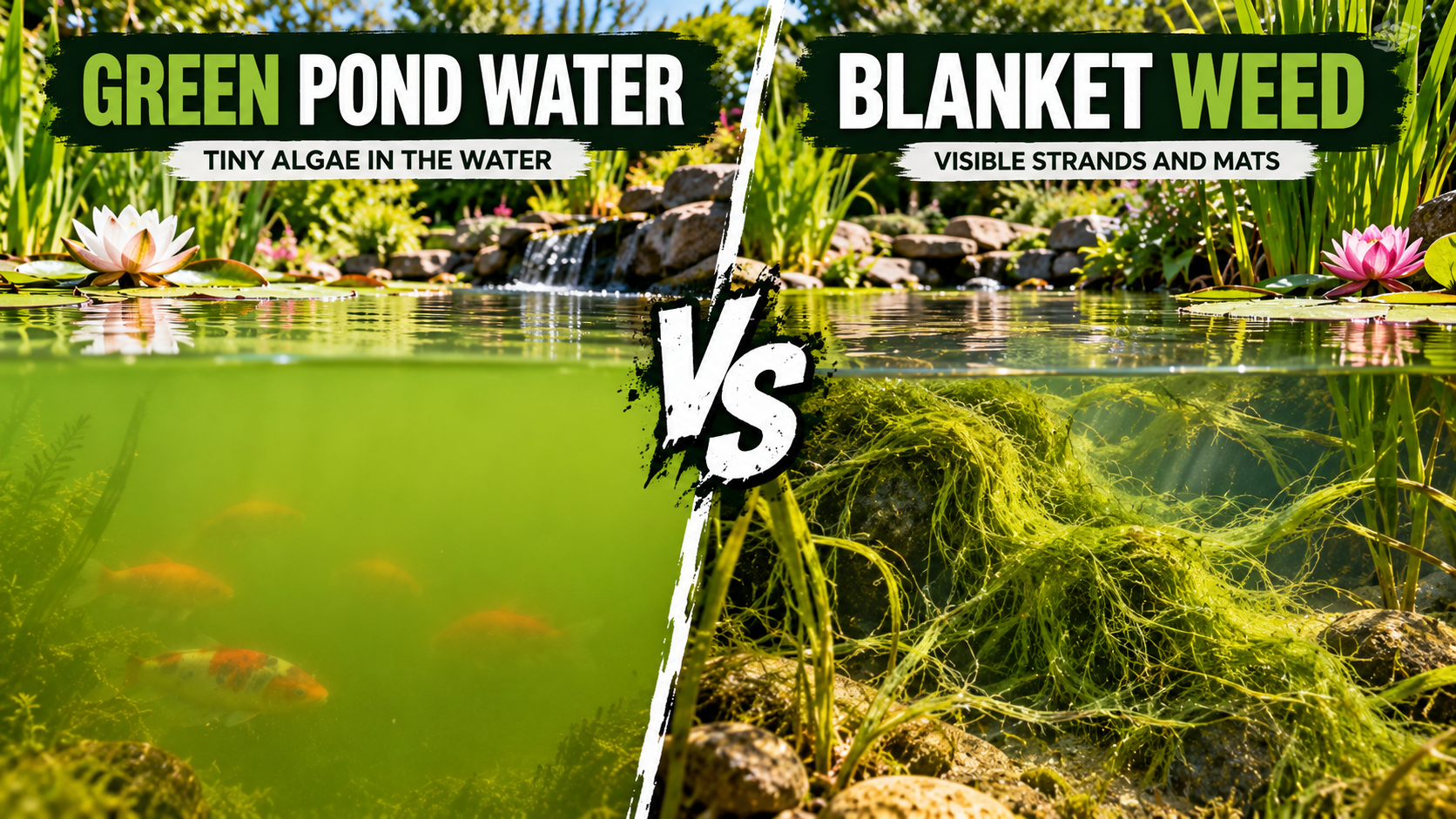
Two of the most noticeable algae problems in garden ponds are green water and blanket weed. People often discuss them as though they're interchangeable, but they're easy to distinguish once you know what to look for.
Green water turns the water itself cloudy or pea-soup green.
Blanket weed produces visible green strands, clumps or mats that can float through the pond, cling to plants or gather around the edges.
Knowing the difference matters because something designed to tackle suspended green-water algae won't necessarily solve a mass of stringy blanket weed.
Let's work out which one you've got.
QUICK IDENTIFICATION
Is it green water or blanket weed?
Start with a simple place: look at what is actually green.
If the water itself appears green and cloudy, and you can't easily scoop the green material out with a net, you're probably looking at green water caused by microscopic algae suspended throughout the pond.
If the water contains visible strands, threads, clumps or mats of green growth, you're more likely dealing with blanket weed.
Blanket weed is physical material. You can usually lift, rake, scoop or twirl it from the water.
Green-water algae are far too small to remove that way.
That basic distinction tells us a surprising amount about what to do next.
GREEN WATER
What does green pond water look like?
The classic description is pea soup.
Instead of seeing clearly through the pond, the water develops a green tint that can range from slightly cloudy to intensely opaque.
The cause is huge numbers of tiny algae suspended throughout the water.
You may still have perfectly normal pond plants beneath the surface, but the suspended algae make them increasingly difficult to see.
In severe cases, even fish can disappear from view until they swim close to the surface.
Because these algae are microscopic, trying to remove them with a pond net won't do much.
If that sounds like your pond, read our full guide to why pond water turns green, where we look at the causes and longer-term solutions in detail.
BLANKET WEED
What does blanket weed look like?
Blanket weed is much easier to see as an individual growth.
Rather than colouring the entire body of water, filamentous algae develop into long, hair-like green strands.
Those strands can cling to pond plants and surfaces, float beneath the water or form dense mats.
You may hear it called blanket weed, silkweed, string algae or filamentous algae.
Run a stick through a patch and the strands can often wind around it almost like green wool.
That physical structure is the giveaway.
If you can grab the green stuff, wind it around a stick or pull a clump from the water, it isn't the microscopic algae responsible for pea-soup green water.
SIDE BY SIDE
The easiest way to tell them apart
Think of it this way:
Green water = green in the water.
Blanket weed = green material in the water.
With green water, the colour follows the water itself. Fill a clear container from the pond and the water may retain a noticeable green tint because microscopic algae are suspended within it.
With blanket weed, you're looking for physical strands or mats.
A pond can also contain both at the same time, so don't assume identifying one rules out the other.
Hundreds of types of algae exist, and garden ponds often contain algae even when owners barely notice it.
The objective isn't necessarily to eradicate every trace of algae.
It's to prevent excessive growth from becoming a problem.
WHY IT HAPPENS
Do green water and blanket weed have the same cause?
They can share many of the same favourable conditions.
Algae use sunlight for photosynthesis, so sunny ponds can provide excellent growing conditions.
High nutrient levels can also encourage excessive algae growth.
Those nutrients can enter or accumulate in garden ponds in several ways, including soil entering the water, fertiliser runoff, decomposing organic material and — in ponds containing fish — fish food and waste.
Tap water can also introduce nutrients, which is one reason rainwater is generally preferred for topping up wildlife ponds where practical.
That means recurring algae can sometimes reflect the pond's wider conditions rather than an isolated invader that simply needs killing.
Understanding where excess nutrients are coming from can therefore be more useful than repeatedly treating the visible algae.
GREEN WATER CONTROL
What can you do about green pond water?
Start with the conditions that allowed the algae to thrive.
Reduce unnecessary nutrient inputs, prevent fertiliser and ordinary garden soil entering the water, avoid overfeeding fish and remove excessive decaying organic material where appropriate.
Aquatic planting can help too. Floating-leaved plants such as waterlilies provide shade, reducing the amount of direct light reaching the water.
In ornamental fish ponds, filtration and ultraviolet clarifiers can also form part of a green-water management system.
But size equipment for the actual pond and its fish load.
If you don't know how much water your pond contains, use our Pond Volume Calculator before comparing filtration equipment.
And don't assume that completely emptying a green pond is the answer. If the conditions that caused the bloom remain unchanged, replacing the water alone won't solve the underlying problem.
BLANKET WEED CONTROL
What can you do about blanket weed?
Blanket weed's physical structure often makes manual removal possible.
In a small pond, you can twirl strands around a rough stick or cane, or carefully lift them with a net or rake.
Wildlife needs consideration when doing this.
Pond vegetation can contain small aquatic animals, so check removed material carefully. In wildlife ponds especially, avoid aggressively stripping the entire pond in one session.
Removing excessive blanket weed also removes some of the nutrients contained within that algal growth rather than leaving the material to die and decompose back into the pond.
Longer term, address the same underlying factors that encourage other algae: nutrient availability, sunlight, and the overall balance of planting.
Blanket weed may need repeated management during periods of rapid growth rather than disappearing after one removal.
UV CLARIFIERS
Will a UV clarifier get rid of blanket weed?
This is where identifying the algae matters most.
UV clarifiers are commonly used in ornamental pond systems to tackle suspended green-water algae as water passes through the unit.
Blanket weed is different.
It grows as attached or floating filamentous strands in the pond, rather than travelling through the filtration system like microscopic suspended algae.
So buying a UV clarifier because you've seen a mass of stringy blanket weed may not solve the problem you're trying to fix.
Before buying equipment, identify the algae first.
Green cloudy water and stringy green growth might both be called “algae”, but that doesn't make them the same filtration problem.
WILDLIFE
Is algae always bad for a pond?
No.
Algae are a natural component of pond ecosystems, and some algae can provide food and shelter for wildlife.
This is especially important when considering wildlife ponds.
A perfectly clear, algae-free pond isn't automatically healthier than one containing some natural algal growth.
Problems arise when growth becomes excessive.
Dense algae can interfere with other pond plants and, in some cases, reduce oxygen levels.
The sensible goal is therefore balance, not sterility.
If you have a wildlife pond with modest algae growth and plenty of healthy pond life, doing nothing may sometimes be more appropriate than launching an aggressive treatment programme.
DON'T CONFUSE THEM
Why correct identification can save you money
Pond products can get expensive remarkably quickly.
Pumps, filters, UV clarifiers, treatments and cleaning equipment all have legitimate uses in the right circumstances.
But buying equipment before understanding the problem is an easy way to spend money without fixing anything.
If your pond resembles pea soup, investigate suspended green-water algae.
If you're pulling long green strands from the water, investigate blanket weed.
If the water is brown, grey or simply cloudy rather than green, you may be dealing with suspended sediment, organic debris or another water-quality issue entirely.
Diagnose first.
Buy second.
That's a principle we'll stick to throughout PondStuff's equipment guides.
QUICK ANSWER
Green water or blanket weed?
Here's the short version.
Green pond water usually comes from microscopic algae suspended throughout the water. It makes the water look green and cloudy, and you can't simply pull it out by hand.
Blanket weed consists of filamentous algae that form visible green threads, strands, clumps or mats. Because it has a physical structure, you can often remove it by hand.
Both can be encouraged by abundant sunlight and elevated nutrient levels.
Both are natural forms of algae.
And neither automatically means your pond is a disaster.
Identify which one you have, look for the conditions encouraging excessive growth and choose a solution appropriate to that particular problem.
Your pond doesn't need to be sterile.
It needs to be balanced.