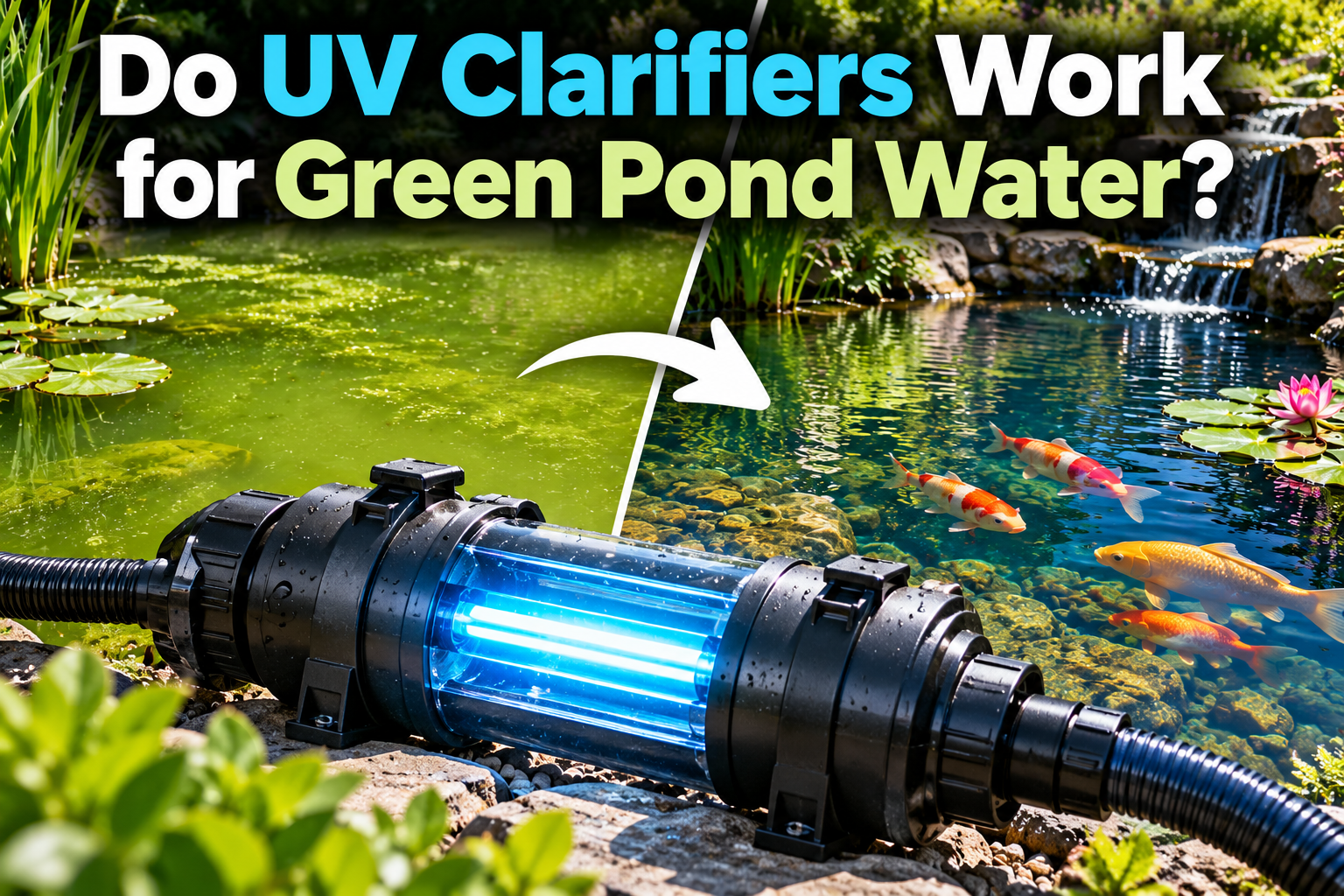
If your pond has turned into a green soup, you may have heard that a UV clarifier is a magic cure. In many situations a correctly sized and installed UVC unit will remove suspended single‑celled algae and give rapid visual improvement. But UV is not a complete fix: it won’t remove dissolved nutrients, clean up sediment, or tackle attached filamentous algae. This article explains how UV clarifiers work, when they’re appropriate (and when they’re not), and what else you need to do to stop the green water coming back.
The basic answer
Yes — but only for planktonic green water
UV clarifiers (often called UVC units) are effective at treating green “pea‑soup” water caused by planktonic algae — the tiny, free‑floating single‑celled algae that colour the whole water column. When water passes the UVC lamp the ultraviolet radiation damages the algae so they clump or die and can then be trapped by a mechanical filter or settle out.
Importantly, UV treats the symptom (suspended algae) rather than the root causes. If nutrient inputs and sediments remain high, algae will regrow once the UV is removed or if the unit is undersized or poorly operated.
How it works
Mechanism: physical, not chemical — and working in the flow path
UVC clarifiers are a physical treatment. They expose pond water that is pumped through the unit to ultraviolet radiation. That radiation damages microscopic organisms’ cells and DNA so they stop multiplying and form particles that can be removed by a filter or settle out.
Because the treatment only affects water that passes through the UVC chamber, a correctly designed circulation path and adequate flow are essential. The unit cannot instantly sterilise the whole pond — it reduces the concentration of planktonic algae over time as water continually cycles through the clarifier.
When to consider UV
Best fits: stocked ornamental and fish ponds with planktonic algae
UV clarifiers are widely used in ornamental garden ponds and fish ponds where clear water is a priority. In these settings they are commonly integrated into a pump + mechanical + biological filtration system and can give a rapid visual improvement when the problem is suspended algae.
For koi or heavily stocked ponds, UV is often one part of a larger, multi‑stage filtration approach. Manufacturers and suppliers stress that the UV must be matched to pond volume and fish load; it isn’t a one‑size‑fits‑all gadget.
When UV is less suitable
Not the answer for wildlife ponds or attached/filamentous algae
For wildlife ponds, the priority is usually maintaining natural food webs and avoiding interventions that upset ecological balance. Freshwater Habitats Trust and other bodies treat UV as an engineered option rather than a first choice for wildlife ponds.
UV will not clear filamentous or attached algae (often called blanket weed), rooted plants or surface mats that are anchored. If your pond’s problem is blanket weed or heavy growth of long strands, physical removal, shading, planting or other methods will be needed — see our guide on Green Pond Water vs Blanket Weed for help identifying the issue.
Practical realities
Sizing, continuous operation and maintenance matter
A UV clarifier’s performance depends on correct sizing, proper plumbing and regular upkeep. Manufacturers set guidance based on pond volume and fish load, and they typically require the unit to be integrated with filtration and circulation. An undersized unit or one installed with the wrong flow path will be ineffective.
UVC lamps lose output with age and quartz sleeves and housings can foul, so routine cleaning and lamp replacement are necessary to maintain performance. Many manufacturers advise sustained daily operation rather than short bursts, and they recommend switching the unit off when dosing live bacterial products so those additives can establish in the filter.
Because these are electrical devices, always follow the product manual and safety instructions supplied by the manufacturer rather than relying on general advice.
Complementary measures
Long‑term clarity needs nutrient control and good filtration
Even the best UVC clarifier won’t lower dissolved nitrates or phosphates — the nutrients that feed algal growth. Long‑term control requires reducing nutrient inputs and removing sediment: avoid adding soil or turf around the pond, minimise fish stocking and feeding where possible, and consider removing accumulated sludge.
Encouraging submerged plants and healthy zooplankton can help compete with algae, and manual removal or treatments like barley straw or pond dyes are other tools that may be appropriate depending on your pond type. For an overview of causes and fixes for green water, see our guide on Why Is My Pond Water Green?
What to expect
Rapid visual improvement — but not a permanent cure on its own
A well‑matched UV clarifier can produce a noticeable improvement in water clarity because it removes the suspended cells that make the water look green. However, it is not a permanent cure unless you also tackle the nutrient sources and keep the unit maintained and running as required.
If clarity returns after switching the unit off or during warm, nutrient‑rich periods, that’s a sign the underlying nutrient problem remains and needs attention alongside the clarifier.
Choosing and installing
Get the system right — consult product guidance and consider the whole setup
When thinking about buying a UV clarifier, consider it as part of a system: pump capacity, mechanical solids removal and biological filtration are all part of reliable control. Don’t rely on UV alone to manage water quality.
Manufacturers provide specifications, installation instructions and recommended pairings. Consult those details for the exact model you’re considering rather than using generic figures, and use a pond volume tool if you need to check your pond’s size: Pond Volume Calculator. If you’re unsure about plumbing or electrical safety, get professional help for installation.