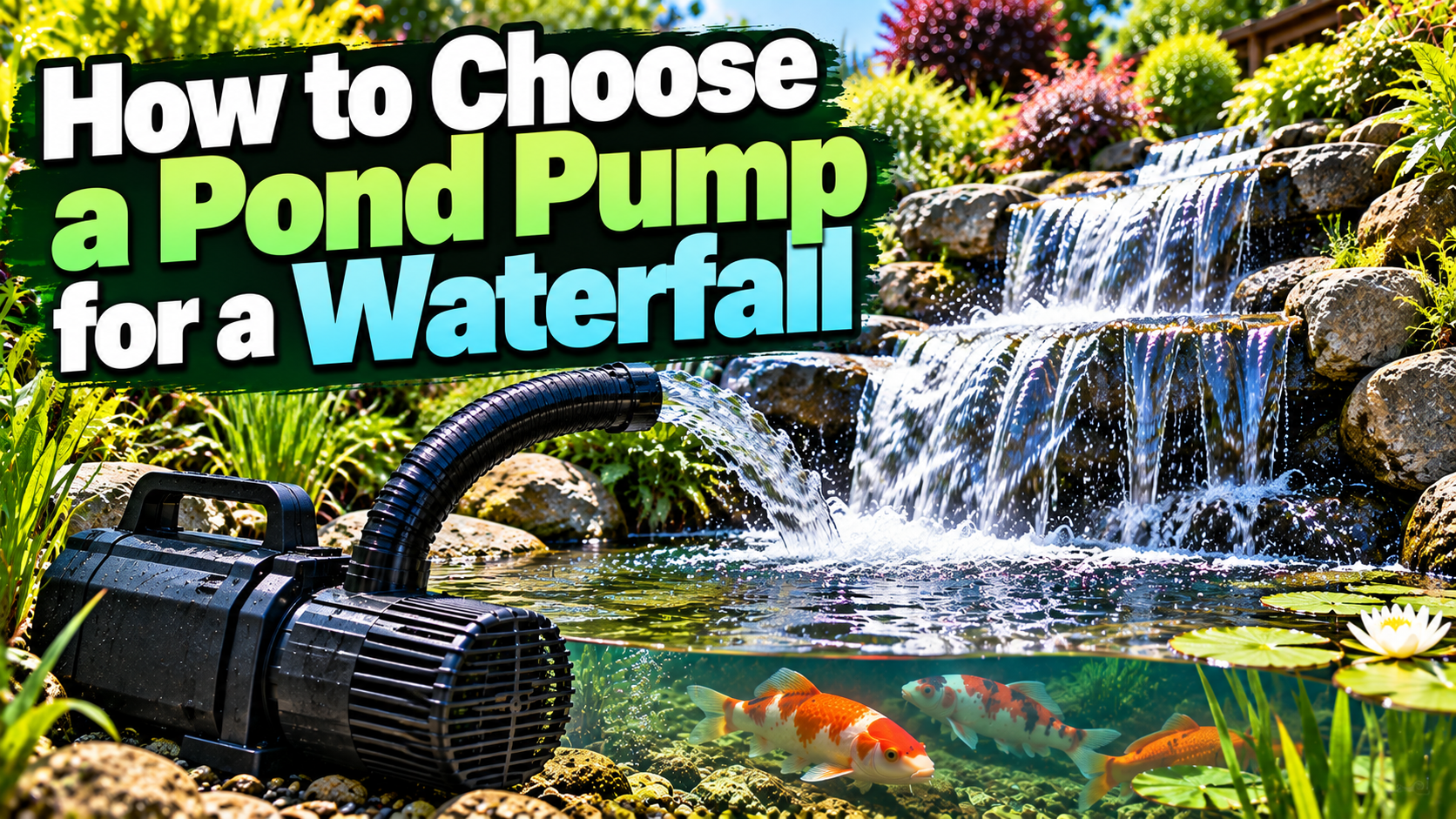
A waterfall pump is not just “the most powerful one” on the shelf. You must match the pump’s flow (volume per hour) to the look you want, and make sure it can deliver that flow against the height and plumbing losses. That combination — flow at the required head — is what determines a suitable pump. This article explains the practical steps to size and choose a pump, the plumbing and safety issues that affect performance, and the different approaches for wildlife, ornamental, fish, and koi ponds.
Quick answer
Match flow and head — that’s the job of the pump
For a waterfall, you need two linked numbers: a target flow (how many litres per hour you want over the fall) and the pressure the pump must overcome to push that flow up to the top. The pressure requirement is called Total Dynamic Head (TDH) — essentially vertical lift plus friction losses in the plumbing. Pick a pump that delivers your target flow at the calculated TDH, and that runs close to its best-efficiency point on the manufacturer’s pump curve.
This guide explains how to pick the flow you want, measure the head, allow for plumbing losses and then choose the right pump type and features for your pond and waterfall.
Visual starting point
Decide the waterfall look — it drives the required flow
Begin with how you want the waterfall to look. A wide, thin sheet of water needs a very different flow than a narrow, roaring drop or a stepped cascade. Manufacturers and specialists commonly provide guideline flow bands for appearance. One commonly cited set of bands expresses flow in gallons per hour (GPH) per foot of waterfall width for low, medium and high-volume looks; you can convert GPH to litres per hour by multiplying by 3.785 if you prefer metric.
Use a band that matches your intended effect, then multiply by the waterfall width to get a target flow. Treat these bands as starting points — final selection must use TDH and the pump curve to confirm the right unit.
If you want more guidance on how much flow you’ll actually need for different effects, see our explainer on pond pump flow rates: Pond Pump Flow Rate Explained.
Measure properly
Work out the Total Dynamic Head (TDH)
TDH is the sum of the vertical lift (the height from the water surface to the top of the fall) and friction losses from pipe runs, fittings and any equipment in line. Don’t ignore either component: a long run of undersized pipe or many sharp bends can add significant friction and reduce delivered flow.
Steps to calculate TDH: measure the vertical distance from the pump water level to the top of the fall; decide the pipe route and count length, diameter and fittings; use a friction-loss table or manufacturer guidance to estimate friction loss at your planned flow rate; add vertical lift and friction loss to get TDH. For a practical primer on head height and why it matters, see: Pond pump head height explained.
If you’re unsure about friction-loss math, note the principle: use the largest practical pipe diameter and keep runs short and straight to minimise losses — the plumbing choices you make can be as important as the pump you buy.
Plumbing matters
Choose pipe, fittings and layout to minimise friction losses
Friction loss rises sharply when you force a high flow through a small pipe or many tight bends. A single larger-diameter pipe usually produces lower friction than several smaller pipes with the same combined area. So, pick the biggest practical internal diameter for the flow you need, avoid unnecessary reductions, and keep the run as straight and brief as possible.
When planning, include any valves, unions, barbed fittings and overflows in your friction-loss calculation — each fitting adds resistance. Manufacturers’ friction-loss charts are the right place to get precise figures; if you don’t have those, consult a standard friction-loss table used in irrigation and plumbing design.
Good piping choices reduce energy use, make the waterfall more reliable, and can let you use a smaller pump while keeping the same visual effect.
Pump selection
Choose a pump that gives the target flow at the calculated TDH
With your target flow and TDH known, consult manufacturers’ pump curves. A pump curve shows flow on the horizontal axis and head on the vertical axis; choose a pump that intersects your TDH at the flow you need, ideally near the pump’s best-efficiency point, not at the extremes.
Consider pump features as well: continuous-duty rating, thermal or overload protection, dry-run protection, and whether the unit is submersible or in-line. “Waterfall” pumps are a useful category because they’re designed to move large volumes and tolerate the sorts of heads waterfalls require, but always match the pump curve to your TDH and flow requirement. Also check fitting compatibility and available accessories so the pump connects cleanly to your chosen plumbing.
Do not choose a pump solely by quoted maximum flow; that figure is at zero head and is irrelevant unless your waterfall is at the pump level.
Pond type first
Different ponds need different pump and filtration choices
Consider what the waterfall will serve—wildlife, ornamental, fish, or koi—because that affects whether you should run heavy filtration, UVCs, or higher flows.
Wildlife ponds: these often benefit from minimal circulation to preserve invertebrates and amphibian larvae. Avoid strong continuous UVC treatment if your priority is biodiversity, and use intake guards to prevent trapping wildlife. If you do add a waterfall for oxygenation or appearance, keep flows modest and protect intakes.
Ornamental ponds: appearance is usually the main aim; combined internal units (pump/filter/UVC) can work for small ponds but have limits. Fish ponds: you’ll need mechanical and biological filtration sized to pond volume and stocking; make sure the pump can reliably feed the filter and provide adequate turnover. Koi ponds: require robust, continuous-duty pumps and large-capacity filtration due to heavy biological loading; for these systems consult specialist suppliers and verify pump curves at the expected TDH.
For information about whether you need a filter and what types suit different ponds, see our pieces on Do I Need a Pond Filter? and Pressurised vs gravity pond filters. If you’re sizing a filter too, our What size pond filter do I need? guide can help.
Ecology & safety
Protect wildlife, follow electrical safety rules and expect water loss
Waterfalls increase overspray and evaporation—expect more frequent top-ups and check water levels regularly. Cascades and high-volume falls are common causes of falling pond levels, so plan a reliable top-up or monitoring system.
Protect wildlife: fit intake guards or wildlife-safe screens so amphibians, fish fry and invertebrates are not trapped. Unprotected intakes can harm small animals.
Electrical safety is vital. Any permanent wiring or fixed socket installations should be done by a qualified electrician. Use appropriate weatherproof sockets, correct earthing and ground-fault protection as specified by regulations and the pump manufacturer. Never improvise electrical connections or attempt significant wiring work yourself unless you are a qualified professional.
Commissioning & care
Commission your system, then maintain and monitor it regularly
After installation, start the system and monitor flow, water level and clarity. Biological filters need time to establish their bacterial colonies; these populations can take around six weeks to develop and are vulnerable if filters or pumps are switched off for long periods. Follow manufacturer commissioning instructions and keep pumps running as recommended during that period.
Routine maintenance includes cleaning mechanical media, checking impellers and seals, replacing UVC bulbs on schedule if fitted, and clearing debris from intakes. Keep a simple log of water level, flow behaviour and fish condition — it helps spot gradual problems before they become serious.
If you need to estimate pond volume for filtration or turnover calculations, use a pond volume calculator to get a useful baseline: Pond Volume Calculator.
Common pitfalls
Mistakes to avoid when sizing and installing a waterfall pump
Common errors that cause poor performance or unnecessary cost include:
Choosing a pump based on quoted maximum flow alone, without checking flow at your TDH.
Using undersized pipework that creates excessive friction losses.
Installing strong continuous filtration or UVCs in a wildlife pond without considering impacts on microfauna and larvae.
Failing to protect intakes, which can trap amphibians and invertebrates.
Doing permanent electrical work without a qualified electrician or ignoring manufacturer installation guidance.
Address these points early in the design and you’ll avoid most performance and welfare issues.