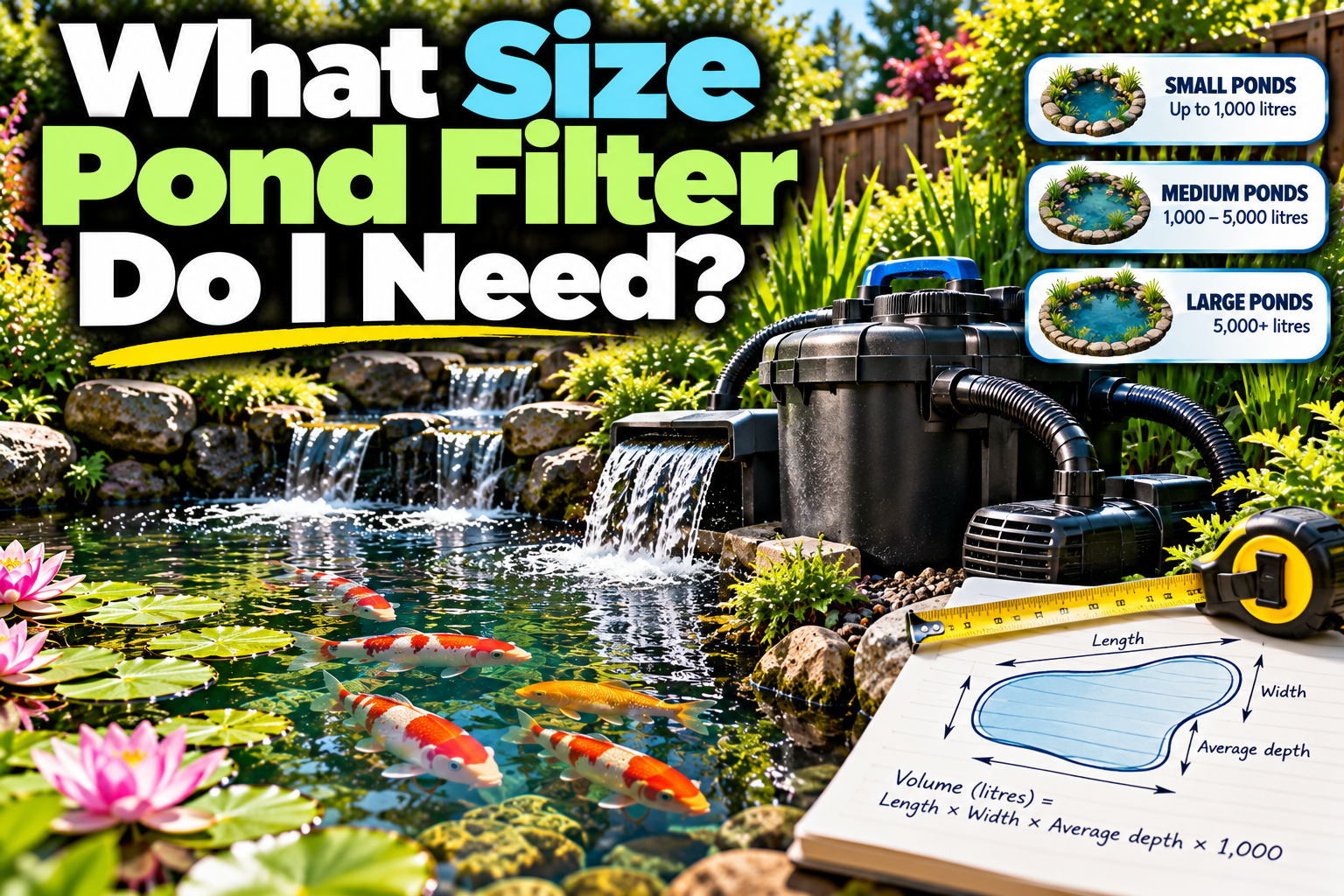
There’s no single ‘filter size’ that fits every garden pond. The correct choice depends first on how much water you have, then on how many and what kind of fish live in it, and finally on the type of filtration you need. Get the sizing wrong and you risk cloudy water, stressed fish or overworked equipment. This article takes you step by step through measuring your pond, assessing fish load, choosing a filter style and following manufacturer capacity guidance so you match equipment to your pond’s real needs.
Quick answer
Why filter size matters for fish health and water clarity
Filters do two main jobs: mechanically removing solids and providing media for the beneficial bacteria that break down fish waste. If a filter is too small for the pond volume and fish stocking it will clog quickly, fail to process ammonia effectively and won’t keep the water clear. Conversely, an oversized, inappropriate type of filter can be wasteful or unsuitable for your pond layout.
Authoritative UK guidance stresses the sequence: calculate pond volume, decide the fish load, then follow the manufacturer’s sizing tables and pump/filter pairings rather than relying on generic rules of thumb.
Start here
Work out the exact pond volume
Before you can size a filter you must know how much water you have. The simplest approach for irregular ponds is average length × average width × average depth. Convert cubic metres to litres by multiplying by 1,000, or use the calculator if you prefer not to do the maths yourself.
If you’d rather not calculate by hand, use the PondStuff pond volume calculator to get an accurate figure in litres or cubic metres. Record the units—manufacturer tables may use litres, cubic metres or gallons, and you must match units when comparing equipment.
Stocking matters
Decide whether your fish load is light, medium or heavy
Filter capacity for the same pond volume varies with fish load. Manufacturers normally give different maximum pond volumes for light, medium and heavy stocking. In general:
- Light: a few small goldfish, minimal feeding and low biomass.
- Medium: several garden fish or larger individual fish with regular feeding.
- Heavy: multiple large fish (especially koi) or intensive feeding and high biomass.
These categories are qualitative. When in doubt, be conservative: treat uncertain stocks as a heavier load and choose equipment rated for that category. For koi and other high-biomass situations, expect to move to specialist, heavy-duty systems rather than small internal units.
Match the system
Pick the right filter style for your pond type
Filter style matters as much as rated capacity. Common options include small internal filters, pressurised external canisters, pump-fed multi-stage systems and larger gravity-fed biological filters. Each has strengths and limits:
- Internal filters suit small, lightly stocked ponds for basic mechanical and biological filtration.
- Pressurised external units can be compact and useful for moderate loads—check manufacturer limits for heavier stocking.
- Gravity-fed and large flow-through systems are preferred for heavily stocked ponds and koi, because they offer greater biological media volume and easier maintenance.
Read more about the roles of mechanical and biological filtration to understand what your pond needs for solids removal versus nitrification.
Learn the difference between mechanical and biological filtration
Manufacturer rules
Match pond volume and fish load to the manufacturer's sizing table
Many manufacturers publish explicit pairing tables that say, for example, this filter model (with a specified pump and optionally a UVC) is suitable for up to X litres at a light load and Y litres at a heavy load. The recommended workflow is: calculate pond volume, determine fish load, then consult the manufacturer’s table for the exact model you’re considering.
OASE and other reputable manufacturers follow this stepwise approach. Use their model-specific charts rather than generic turnover multipliers; if the table uses gallons, convert accurately to litres or cubic metres before comparing.
If a product page or table is unclear, ask the supplier for the exact capacity for your pond volume and stocking level. Manufacturers’ ratings are the correct basis for sizing because they account for the filter’s internal media volume, flow characteristics and intended pump pairings.
Clarify green water
Where UVC fits — and where it doesn't
UVC clarifiers help control free-floating algae (green water) by causing the cells to clump so the filter can remove them. However, UVCs do not remove dissolved nutrients that fuel algae growth. If green water returns shortly after treatment, the root cause is usually excess nutrients from silt, runoff, overstocking or heavy feeding.
Use UVC as part of a wider plan: effective mechanical solids removal, good biological filtration, nutrient management and planting. For more on green water and UVCs, see our guides on whether UV clarifiers work and how to clear green pond water.
Do UV clarifiers work for green pond water?
How to clear green pond water
Commissioning & upkeep
Start-up, maintenance and keeping beneficial bacteria alive
Biological filters need time to establish their colony of nitrifying bacteria—guidance commonly notes an establishment period of several weeks. During commissioning take things slowly: allow the filter to run and mature before introducing a full fish load.
A few practical points: clean mechanical elements regularly, rinse biological media in pond water rather than tap water to preserve bacteria, replace UVC lamps as the manufacturer recommends, and follow the filter maker’s maintenance schedule. Filters that are switched off for long periods can lose much of their beneficial bacterial population; some guidance warns that switching off for more than about 24 hours can be harmful.
Where electrical equipment is needed, have mains supply work done by a qualified electrician and use properly rated outdoor cabling and sockets. Safety is not optional.
Exceptions & cautions
Wildlife ponds, ornamental ponds and koi—different priorities
Wildlife ponds and ornamental fish ponds have different aims. Freshwater Habitats Trust recommends keeping small wildlife ponds fish-free because fish can rapidly overwhelm nutrient balance and the wildlife value of a small site. If your priority is wildlife, avoid heavy filtration and instead focus on native planting, shading and preventing nutrient inputs.
By contrast, koi ponds have much higher waste production per fish and normally require purpose-built, large-capacity biological and mechanical systems. Many compact filter units aren’t intended for koi or very heavy stocking—consult the manufacturer for koi-specific ratings.
Troubleshooting
When you might need a larger or different filter
Signs that your filter may be undersized include persistent cloudy or green water despite maintenance and UVC use, frequent clogging and rapid build-up of solids, recurring poor water quality symptoms in fish, or unusually large ammonia/nitrite readings (tested with a reliable kit). If you see these signs, check your pond volume and stocking estimate, review the manufacturer’s capacity table for your model, and consider upgrading to a system rated for a heavier stock or switching to a gravity-fed solution for easier servicing.
If you’re unsure, get a specialist opinion from a reputable pond supplier who can work from your pond’s volume and an honest assessment of stocking and feeding. They can recommend the correct pump/filter/UVC pairing and installation layout.