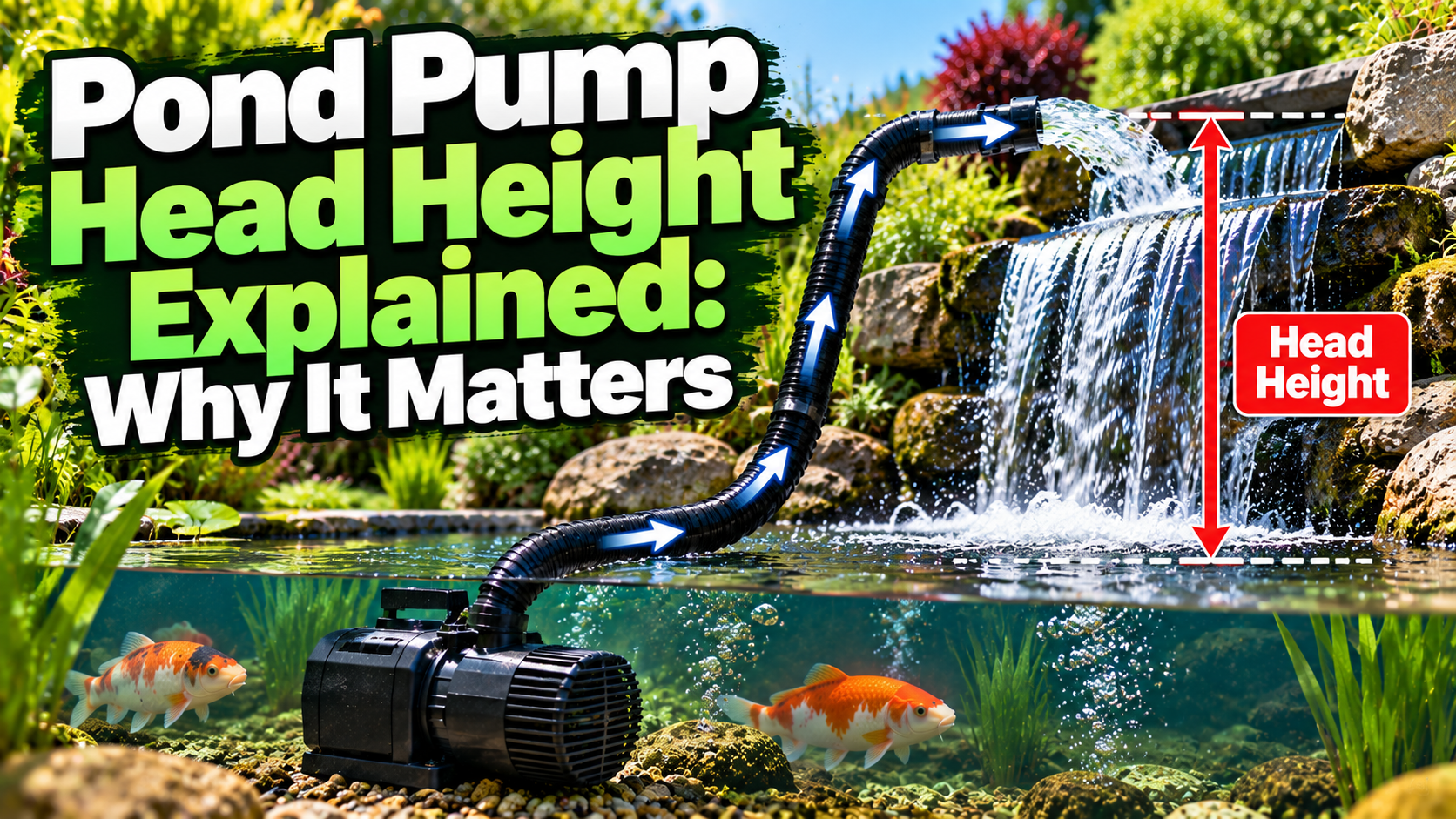
If your waterfall trickles instead of sings, or a new pump 'doesn’t feel powerful', the culprit is often head height — the pressure the pump must overcome to move water. Total Dynamic Head (TDH) combines the vertical lift and losses through pipework. This article explains TDH in plain terms, shows what to measure, and how to use that information to choose and install a pump that gives the right flow for your pond, filter or feature.
Key concept
What 'head height' and Total Dynamic Head (TDH) actually mean
Head height is the pressure a pump must overcome to push water from the pond to the discharge point. In practical pond work, we use Total Dynamic Head (TDH) — the sum of two things: the vertical head (the vertical distance from the pond water surface to the highest outlet, such as a waterfall crest or filter inlet) and the friction head (the losses caused by pushing water through pipes and fittings).
Put simply: TDH = vertical head + friction head. The greater the TDH, the harder the pump must work, and the lower the flow it will deliver. That’s why a pump’s free‑flow rating on the box is rarely what you get once the plumbing and elevation are in place — you must use the pump’s performance curve to know the actual flow at your TDH.
Why it matters
How head height affects flow, energy use and pump life
Pump flow decreases as head height increases. If you pick a pump purely on its headline litres‑per‑hour figure without accounting for TDH, you may find it under‑delivers for a filter or a waterfall. Conversely, a pump operating far below its recommended head range can run inefficiently or at undue mechanical stress.
Operating a pump near its efficient range prolongs its life and saves energy; running it consistently too hard or too easily increases wear and can shorten its lifespan. It also affects pond health—inadequate flow can reduce biological filtration and oxygenation, while excessive flow in a wildlife pond can disturb plants and amphibians.
Practical measuring
How to calculate TDH for your pond — what to measure
To work out TDH you’ll need a few straightforward measurements. Start with the vertical head: measure the vertical distance from the pond water surface to the highest point the water must reach (for example, the top of a waterfall, filter inlet, or fountain head).
Next, estimate friction head. That needs the pipe run length, the internal diameter of the pipe or hose and a count of fittings such as elbows, tees, valves and any in‑line devices (check valves, UV units). Manufacturers publish friction‑loss charts or equivalent length tables that let you convert those details into a friction head figure; add that to the vertical head, and you have your TDH.
If you need help with pond size for filter selection or to think about turnover, see our Pond Volume Calculator before you match pump and filter.
Plumbing matters
How pipe size, length and fittings change the picture
Small‑bore pipe and long runs increase friction head for a given flow. Using a larger internal diameter for the same flow reduces friction losses, so repiping to a bigger bore is often a better fix than upsizing a pump. Every elbow, valve or restrictive fitting adds to friction head — minimise unnecessary bends and avoid tight, twisting routes where you can.
Also bear in mind that some devices (pressure filters, some UVC units) require a certain flow range. Their presence changes the friction head and should be included in your TDH calculation. If you’re fitting a filter or UVC, check the manufacturer’s installation notes and flow recommendations to ensure the pump you choose can supply the required flow at your TDH.
Choosing a pump
Match your TDH and desired flow to the pump curve
Manufacturers publish pump performance curves showing how flow changes with head. The right pump delivers your desired flow at the calculated TDH and does so near its recommended operating band or best efficiency point. Don’t choose by headline litres‑per‑hour alone — read the curve.
If you are also sizing or choosing a filter, remember pumps and filters are a system; select a pump that will deliver the filter’s required flow at the system TDH. If you need guidance on how many litres per hour your pond needs in principle, see our guide on pond pump flow rate and our article on what size pump you need.
Different ponds, different needs
Why wildlife ponds, ornamental ponds, fish ponds and koi ponds need different approaches
Decide what the pump is for before you start sizing. Wildlife ponds often benefit from minimal disturbance; many are best without aggressive pumping or mechanical filtration unless fish are present. If you add a pump, keep flow gentle and avoid strong surface currents that will disturb amphibians and marginal plants.
Ornamental ponds and features are driven by aesthetics — the desired look of a waterfall or fountain determines target flow, and TDH must be calculated to achieve that appearance. For small garden fish ponds, match pumps to filters so biological filtration works properly and oxygen levels stay healthy.
Koi ponds typically require more robust filtration and higher turnover because koi produce more waste. These systems often use larger pumps and purpose‑built filter setups; check filter and pump spec sheets and consult koi‑specialist advice rather than guessing pump sizes.
Common mistakes
Troubleshooting: the usual errors and how to avoid them
Many pond owners choose pumps based on the maximum flow quoted on the box—that figure usually assumes little or no head. Once you add vertical lift and friction, the delivered flow will be lower. Always check the pump curve for flow at your TDH.
Another common error is undersized plumbing. Before buying a bigger pump, consider whether increasing pipe diameter or simplifying the run would reduce friction and achieve the required flow more efficiently. Also allow some head margin if you plan future additions (longer runs, extra waterfalls, extra fittings) so you don’t outgrow the pump.
Finally, resist the temptation to force a pump into a system it isn’t designed for. Some high‑head pumps need a minimum back pressure to operate safely; others are designed for low‑head, high‑flow work. Follow manufacturer guidance rather than improvising restrictive fittings to 'make' a pump behave differently.
Safety first
Electrical and installation considerations you must not skip
Do any electrical work near water safely and in accordance with local regulations. Have a qualified electrician install your pond electrics, and ensure RCD/GFI protection is in place where required. Check that pumps have appropriate safety features for your intended use, such as thermal overload or low‑water protection.
When pumping or draining ponds, take care with silt and wildlife. Stop pumps before they start drawing in settled silt, and manage the discharge so it does not damage habitats. If in doubt about draining or construction work that affects wildlife, seek specialist guidance.
Practical checklist
A simple step‑by‑step TDH and pump‑selection checklist
1. Decide the function and desired flow (waterfall look, filter flow, fountain effect). 2. Measure vertical head from the pond water surface to the highest outlet. 3. Measure pipe run length, note internal diameter and count fittings. 4. Use manufacturer friction‑loss charts to estimate friction head and add to vertical head to get TDH. 5. Consult pump performance curves and select a pump that gives the desired flow at your TDH while operating near its recommended efficiency point. 6. Confirm the pump will meet any filter or UVC flow requirements and that the electrical installation is carried out by a qualified electrician.
For help with pond volume or filter sizing while you plan, see our Pond Volume Calculator and the Pond Filter Calculator, along with articles on whether you need a pond filter and how to choose the right pond filter.