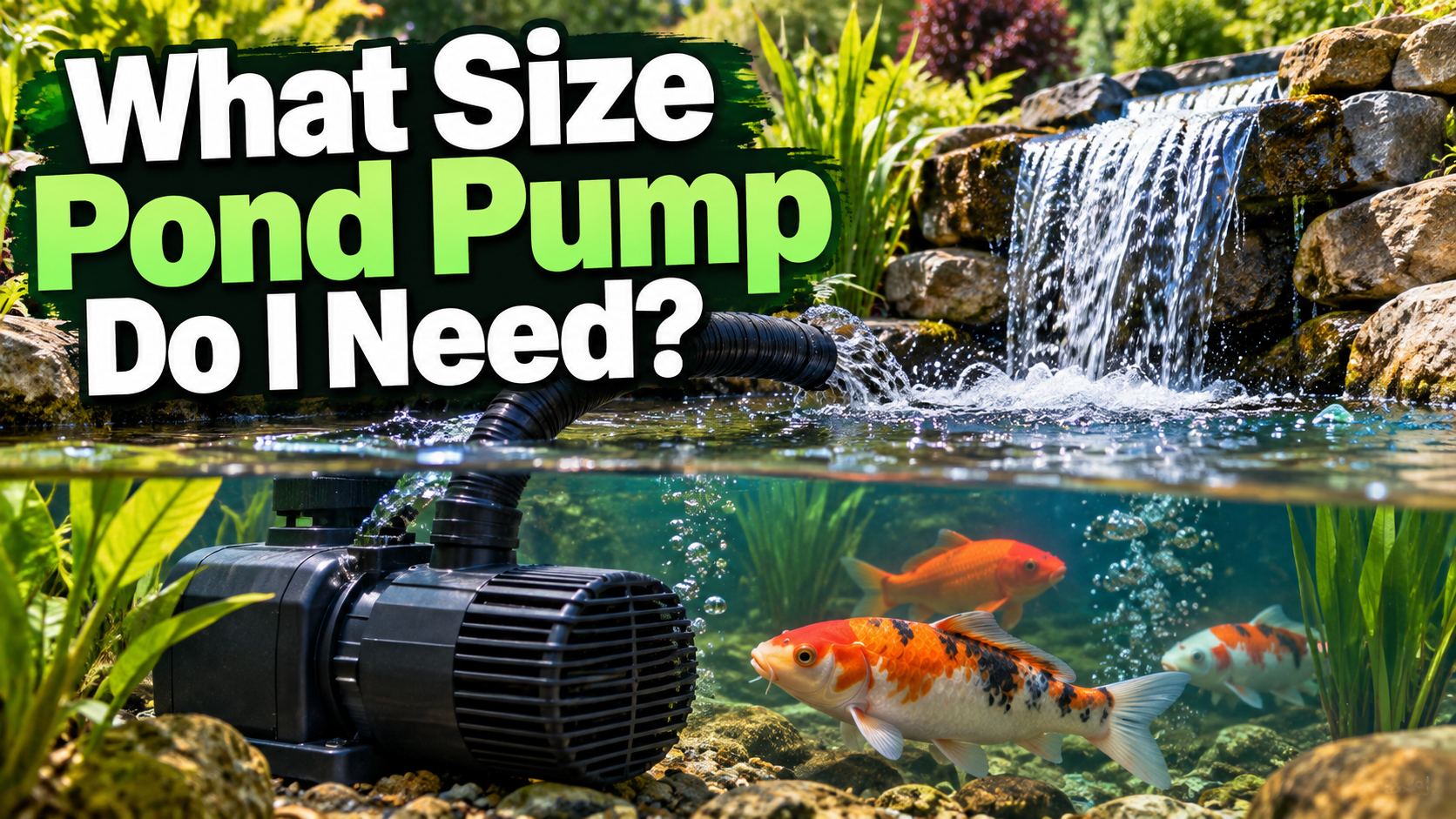
No single pump size suits every pond. The correct choice depends first on your pond’s volume and what you want the pump to do: power a waterfall, circulate water through a filter, or provide aeration. Wildlife ponds often need no pump at all, whereas fish and especially koi ponds demand far more flow and solids-handling. This guide shows you how to measure volume, decide the purpose, estimate flow for features and filtration, understand Total Dynamic Head, and match pump flow to your filter and fish load.
Quick answer
It depends: pond volume, purpose and head
First, note the pond’s volume (in litres) and what you want the pump to do. Pumps are sized by flow rate (litres per hour) and how much head (vertical lift plus friction) they must overcome. For wildlife ponds, a pump is often unnecessary and can be harmful; for ornamental ponds, size the pump to the desired look of a fountain or waterfall; for fish and koi ponds, size the pump to feed a correctly rated filter and handle the fish bioload.
This article explains the steps to pick a pump that delivers sufficient flow at the actual head in your installation and matches any filter you plan to use.
Measure first
How to calculate your pond volume (metric)
Accurate volume is the single most useful number when sizing pumps and filters. For a rectangular pond, measure the length, width and the average depth (not just the deepest point). Multiply these three measurements in metres to get cubic metres, then multiply by 1,000 to get litres. Example: 3.0 m × 2.0 m × 0.6 m = 3.6 m³ = 3,600 litres.
If you prefer imperial units, a commonly used formula for rectangular ponds (from pump/pond guidance) is: volume (US gallons) = length (ft) × width (ft) × depth (ft) × 7.5. Convert to litres if needed.
For circular or irregular shapes, measure as best you can (divide the pond into simple shapes, calculate each volume, and add them) or use our online Pond Volume Calculator to avoid mistakes: /tools/pond-volume-calculator.
Decide the pond type
Wildlife, ornamental, fish or koi — why it matters
Decide the primary purpose before you size anything. Freshwater Habitats Trust advises that wildlife ponds are often best left rain-fed and fish-free — pumps and heavy mechanical filtration can alter the ecology and harm wildlife. If your aim is wildlife habitat, you may not need a pump at all.
Ornamental garden ponds (planted, few or no fish) typically use smaller pumps for water features and modest filtration. Fish ponds and swim ponds need reliable filtration and circulation sized to the pond volume and stocking density. Koi ponds have a much higher solids and waste load and require substantially larger filtration capacity and pumps designed to handle high flows and sizeable solids.
If you’re unsure whether you need a filter at all, read Do I Need a Pond Filter?: /equipment/do-i-need-a-pond-filter.
Flow requirements
How much flow do you need — features vs filtration
Decide whether your primary need is a showpiece (fountain or waterfall) or filtration. For waterfalls and streams manufacturers offer rough guidance in US gallons per hour per foot of waterfall width. One commonly used example from pump guidance gives approximate figures per foot: about 750 GPH/ft for a low trickle, 1,500 GPH/ft for a medium flow and 2,250+ GPH/ft for a dramatic cascade. Converting those figures gives approximate litre/hour ranges per foot of roughly 2,800 L/hr, 5,700 L/hr and 8,500+ L/hr (rounded).
For filtration the principle is different: match pump flow to the filter’s rated flow and to the pond volume plus fish loading. Manufacturer system guides (for example Oase’s Clear Water Guarantee) pair pumps, filters and UV units by pond volume and fish-stock category rather than using a single universal turnover-per-hour rule. See What size pond filter do I need? for more on filter matching: /equipment/what-size-pond-filter-do-i-need.
Total Dynamic Head
Why head matters — calculating TDH (vertical lift + losses)
Pumps are rated by flow at zero head; in practice, you must calculate Total Dynamic Head (TDH)—the vertical lift to the highest discharge point plus friction losses through pipe, fittings, and any filter. TDH determines the actual flow a pump will deliver.
Start with vertical lift: measure from the pond water surface to the top of your waterfall lip or to the inlet height of the filter/UV. Then add friction losses: these depend on pipe diameter, length, material and the number of elbows and fittings. Manufacturers provide friction-loss charts for common pipe sizes that give head loss per metre. Add those losses to the vertical lift to get TDH, then use the pump curve to read the flow the pump will deliver at that head.
We don’t recommend guessing friction losses — use pipe charts and the pump’s performance curve (provided by the pump manufacturer) to select a pump that delivers the required flow at your TDH.
Match pump to filter and fish load
Pair the pump to the filter’s rated flow and your stocking
Filters are rated for maximum flows and for pond volumes under particular stocking assumptions. Use the filter’s recommended flow range: oversizing a pump so that it constantly runs a filter above its rated flow can reduce filtration effectiveness and may damage media or the filter itself.
Manufacturers’ system tables are useful here. For instance, Oase’s Clear Water Guarantee links pond volume and fish load categories (their guidance describes a “garden/swim pond” as up to roughly 1 kg of fish per 1,000 litres, and a koi pond at roughly 1–2 kg per 1,000 litres) to recommended pump + filter + UV combinations. Where possible, follow the manufacturer’s paired recommendations rather than applying a single turnover rule to every pond.
For help choosing a filter that matches your pump, see How to Choose the Right Pond Filter: /equipment/choose-the-right-pond-filter and the Pond Filter Calculator: /tools/pond-filter-calculator.
Worked example
Example: estimating flow for a small ornamental pond with a 1 m waterfall
Step 1 — volume. Suppose the pond is 3.0 m long × 2.0 m wide with an average depth of 0.6 m. Volume = 3.0 × 2.0 × 0.6 = 3.6 m³ = 3,600 litres.
Step 2 — desired waterfall flow. Using the waterfall guidance referenced above, a medium-looking flow is about 1,500 US GPH per foot of width, which converts to roughly 5,700 L/hr per foot. A 1 metre-wide fall is about 3.28 feet, so the same medium-flow guidance implies roughly 18,000–19,000 L/hr for a 1 m width (use the exact conversion if you need precision for pump selection).
Step 3 — TDH. Measure vertical lift from pond surface to the top of the waterfall; if that lift is 1.0 m, the vertical head is 1.0 m. You must also add friction losses from the pipe run — consult the pipe manufacturer’s friction chart to find loss in metres per metre for your chosen pipe diameter, multiply by the run length, then add for fittings. The sum of vertical lift and friction losses is your TDH.
Step 4 — select a pump. Use the pump performance curve to find a pump that gives your required flow at the calculated TDH. If the curve isn’t clear, contact the supplier or refer to manufacturer pairings for similar-sized features. Remember to select pipe diameter and fittings that keep friction losses reasonable.
This worked example shows how to determine the flow requirement; the final pump choice requires plotting that flow against the pump’s performance curve at your TDH and following the manufacturer’s paired recommendations.
Safety and electricals
Always use a qualified electrician and RCD protection
Electrical safety around water is not optional. In the UK any new outdoor or pond-related electrical work should be installed by a qualified electrician using the correct outdoor-rated cable and equipment and protected by an RCD. If you’re in England, be aware of building and electrical regulations that may apply. The RHS recommends leaving pumps running during hot nights to protect fish when oxygen levels fall — but wiring must be safe and compliant.
Do not attempt to jury-rig waterproofing or run indoor sockets outdoors. If you are unsure about wiring or safe equipment placement, consult a qualified installer.
Maintenance matters
Regular maintenance keeps pumps and water healthy
A correctly sized pump and filter will only perform well if you maintain them. Clean mechanical media, replace worn parts, service or replace UV lamps on schedule, and keep skimmers and strainers clear of leaves and debris. Undersized systems or neglected filters are the most common causes of poor water quality.
For guidance on routine filter care, see How Often Should You Clean a Pond Filter?: /equipment/how-often-clean-pond-filter.
Final checklist
How to proceed: a practical checklist before you buy
1) Measure pond volume accurately and note it in litres.
2) Decide the pond type and primary function of the pump (wildlife, feature, filter feed, koi).
3) For a feature, estimate the desired flow (use waterfall guidance as a starting point and convert to litres per hour).
4) Calculate vertical lift and use pipe friction charts to add losses — that gives TDH.
5) Match pump flow at your TDH to the filter’s rated flow and to the expected fish load (use manufacturer system tables where available).
6) Buy the pump and filter as a matched set where possible, arrange safe electrical installation by a qualified electrician and plan a maintenance routine.
If you’d like worked numerical examples that include pump curve selection and sample filter pairings using manufacturer tables, we can produce them using current supplier data — let us know your pond dimensions and intended stocking.