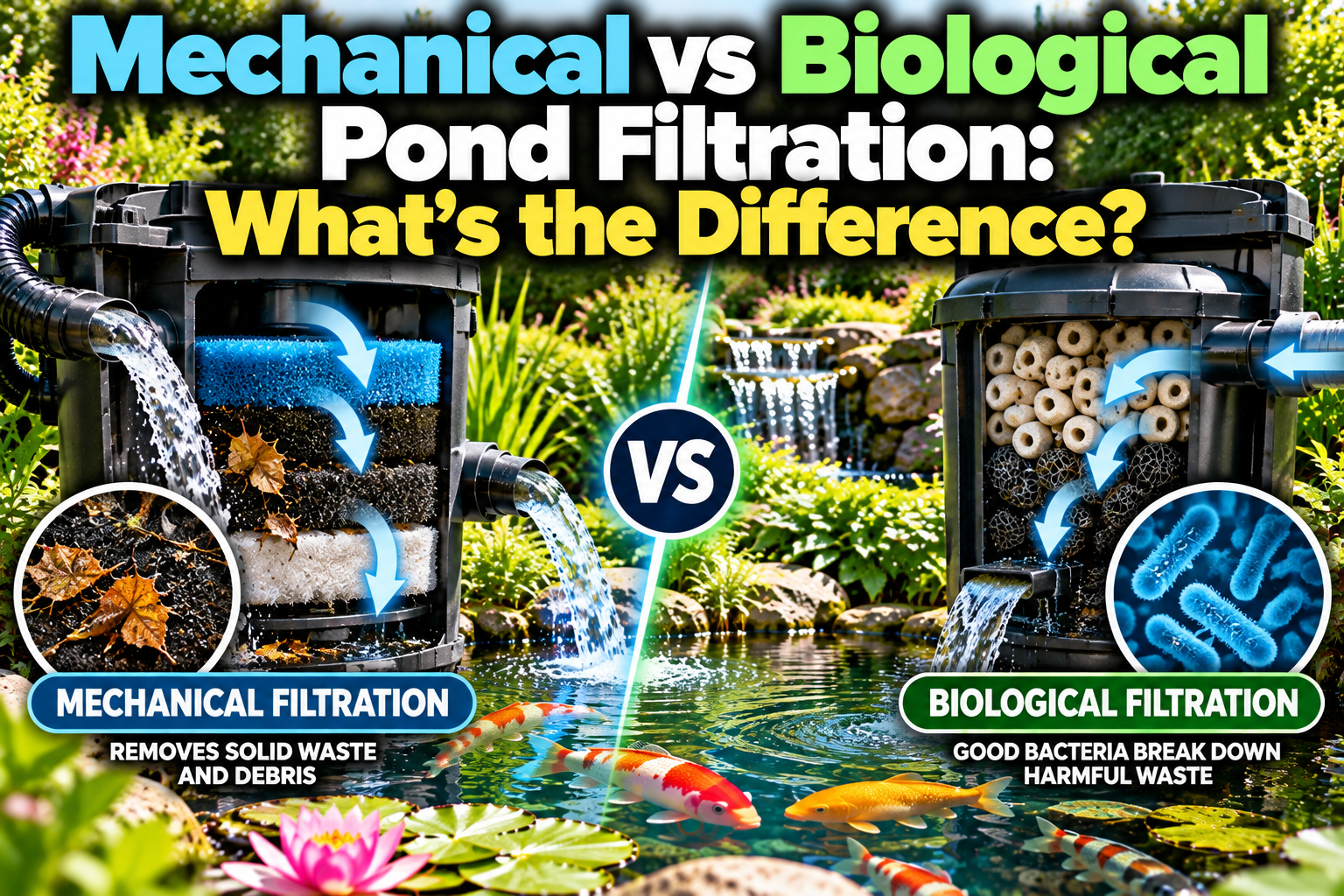
Most pond owners hear the terms 'mechanical' and 'biological' filtration but aren't always clear what each does — or which they need. Mechanical filtration traps solids and clears visible debris immediately. Biological filtration uses colonised media and bacteria to break down dissolved fish wastes over time. This article explains how each works, where each is essential (or not), the common hardware you’ll meet, maintenance basics and safety points so you can choose and care for the right system for your pond.
Key distinction
What mechanical and biological filtration actually mean
Mechanical filtration is the physical removal of suspended solids from pond water. It uses media such as foam pads, fleece, skimmer baskets, sieves or drum screens to trap leaves, algae clumps and other particulates as water passes through. Mechanical filters act immediately when switched on and make the water look clearer by removing visible debris.
Biological filtration relies on communities of beneficial bacteria and tiny organisms that live on high‑surface‑area media (bio‑balls, sintered glass, gravel or specialist biomedium). Those microbes convert dissolved fish wastes — primarily ammonia and nitrite — into less harmful forms and otherwise help break down organic compounds. Biological filtration takes time to establish and needs steady flow and oxygen to work well.
How it works
Mechanical filtration: trapping solids and why it matters
Mechanical filters typically present water with progressively finer barriers: coarse screens first, then finer pads or cartridge material. As solids accumulate they are retained and either need rinsing out or, in the case of disposable media, replacement. High‑performance mechanical units such as drum or automatic screen filters remove very fine solids and are commonly used on heavily stocked koi ponds.
Mechanical filtration reduces the load of settled and suspended solids so downstream biological media isn’t clogged. That helps keep flow rates steady and reduces maintenance on biological stages. Bear in mind mechanical filtration removes particles but not dissolved chemicals — it won’t remove ammonia, nitrite or dissolved nutrients responsible for algal growth.
How it works
Biological filtration: microbes doing the chemistry
Biological filters give water plenty of surface area where beneficial bacteria can colonise. These bacteria are the engines of nitrification — converting fish waste products into less toxic forms — and they break down a range of organic compounds. Biological media is not intended to be scrubbed clean like a foam pad; aggressive cleaning will remove the bacteria and reduce filter performance.
"Biological filters typically take several weeks to establish and can be damaged if the unit is switched off for extended periods." RHS guidance also notes bacterial populations typically take about six weeks to establish, and that colonies can be vulnerable if a biological unit is switched off for roughly 24 hours or more. In practice this means you should expect a biological stage to need time to mature before relying on it for heavy fish loads, and you should avoid extended shutdowns where possible.
Ancillary tools
UVC clarifiers and combined approaches — what they add and don’t
UVC clarifiers (ultraviolet units) are neither mechanical nor biological. They expose passing water to UV light that damages free‑floating algae and can clear ‘green water’ quickly. A UVC helps clarity but does not remove settled solids or change nutrient levels — it treats the symptom (suspended algae), not the underlying nutrient supply.
Most reliable pond systems combine approaches: mechanical pre‑filtration to remove solids, biological media for chemical detoxification, and, where clarity is a priority, a UVC as a clarifier. For heavily stocked koi ponds you’ll often see high‑efficiency mechanical stages (drum or sieve) paired with large biological reactors or moving‑bed media to cope with the load.
Match the system to your pond
Which filtration suits wildlife, ornamental, fish and koi ponds?
Decide your pond’s purpose first. "Wildlife ponds generally do not require filtration; introducing fish increases nutrient loads and can reduce biodiversity." If your aim is wildlife, best practice is typically no fish, generous shallow margins and plants to support a healthy ecosystem; avoid pumping in soil or adding fish food.
Small ornamental garden ponds often use compact internal or external filters that combine mechanical and some biological capacity — these are fine for modest fish numbers. For fish ponds with regular stocking you need a reliable biological stage to process ammonia and nitrite; mechanical pre‑filtration helps keep the bio‑media working. Koi ponds commonly require more robust, multi‑stage systems — automatic drum or sieve units for mechanical removal plus large biological reactors or moving‑bed systems to sustain nitrification under heavy load.
Always match pump flow and filter capacity to the pond’s volume and fish numbers. Manufacturers’ guidance is essential when choosing a model; don’t rely on rule‑of‑thumb numbers without checking product specifications.
Maintenance matters
Keeping mechanical and biological stages working together
Mechanical media needs regular inspection and cleaning because once solids build up they restrict flow and can reduce overall performance. Oase guidance suggests monthly cleaning is a typical starting point, but frequency will depend on leaf fall, stocking and feeding. Rinse mechanical pads or sponges in pond water where possible — using tap water or aggressive cleaning can remove or kill beneficial bacteria if the chambers are shared with biological media.
When cleaning biological media, avoid cleaning everything at once. Retain a portion of colonised media and clean other parts in rotation so bacterial colonies persist. Check UVC lamps and sleeves periodically; UV lamps dim with age and will need replacing per manufacturer guidance. If you switch off a biological unit for service, restart it promptly and monitor water quality while the bacteria recover.
Safety & legal notes
Electrical and wildlife safety you must not ignore
If you need an electricity supply for pumps, UVCs or automatic filters, have the work installed by a qualified electrician to meet legal and safety requirements. Outdoor electrical equipment must be correctly rated and protected. Take care with pumps and inlets: screens and pre‑filters help prevent small animals such as tadpoles or plants being sucked in.
Also consider access for maintenance and plumbing layout: incorrect pump–filter matching or under‑sized plumbing can cause poor flow and damage equipment. If you’re unsure about design or electrics, call a pond specialist or electrician rather than improvising.
Practical checklist
Quick steps to choose and care for the right system
Brief checklist to help decide and maintain a filter system:
- Decide your pond’s purpose (wildlife, ornamental, fish, koi) — that determines whether filtration is appropriate or how robust it must be.
- Use mechanical pre‑filtration to remove solids and protect biological media.
- Expect biological filters to take about six weeks to establish and avoid long shutdowns.
- Match pump flow and plumbing to the filter manufacturer’s guidance — do not guess flow rates.
- Inspect mechanical media regularly and rinse in pond water; stagger cleaning of biological media to preserve bacteria.
- Consider a UVC only as a clarity aid; it doesn’t remove nutrients or settled solids.
- For wildlife ponds, favour plants, margins and minimal human inputs rather than adding filtration or fish.
- Call a qualified electrician for any external power installation and consult a specialist for complex koi systems.
If you want help choosing equipment for a particular pond volume, try a pond volume calculator and consult manufacturers’ datasheets before buying. For guidance on choosing a filter model, see our detailed guide: How to Choose the Right Pond Filter. If your problem is green water, our practical guides on UV clarifiers and clearing green water are useful: Do UV Clarifiers Work for Green Pond Water? and How to Clear Green Pond Water.
When to get help
Call a pro: complex systems, unexplained fish ill‑health or electrical work
If you have a heavily stocked koi pond, persistent water‑quality problems, unexplained fish sickness, or if you plan complex plumbing and electrics, seek professional advice. Manufacturers’ technical support can advise on pump/filter matching for their products. For electrical work always use a qualified electrician. For wildlife ponds, consult habitat guidance before adding fish or equipment — sometimes the best action is to reduce human inputs rather than add filtration.