Water lily
Yellow water lily
Nuphar lutea
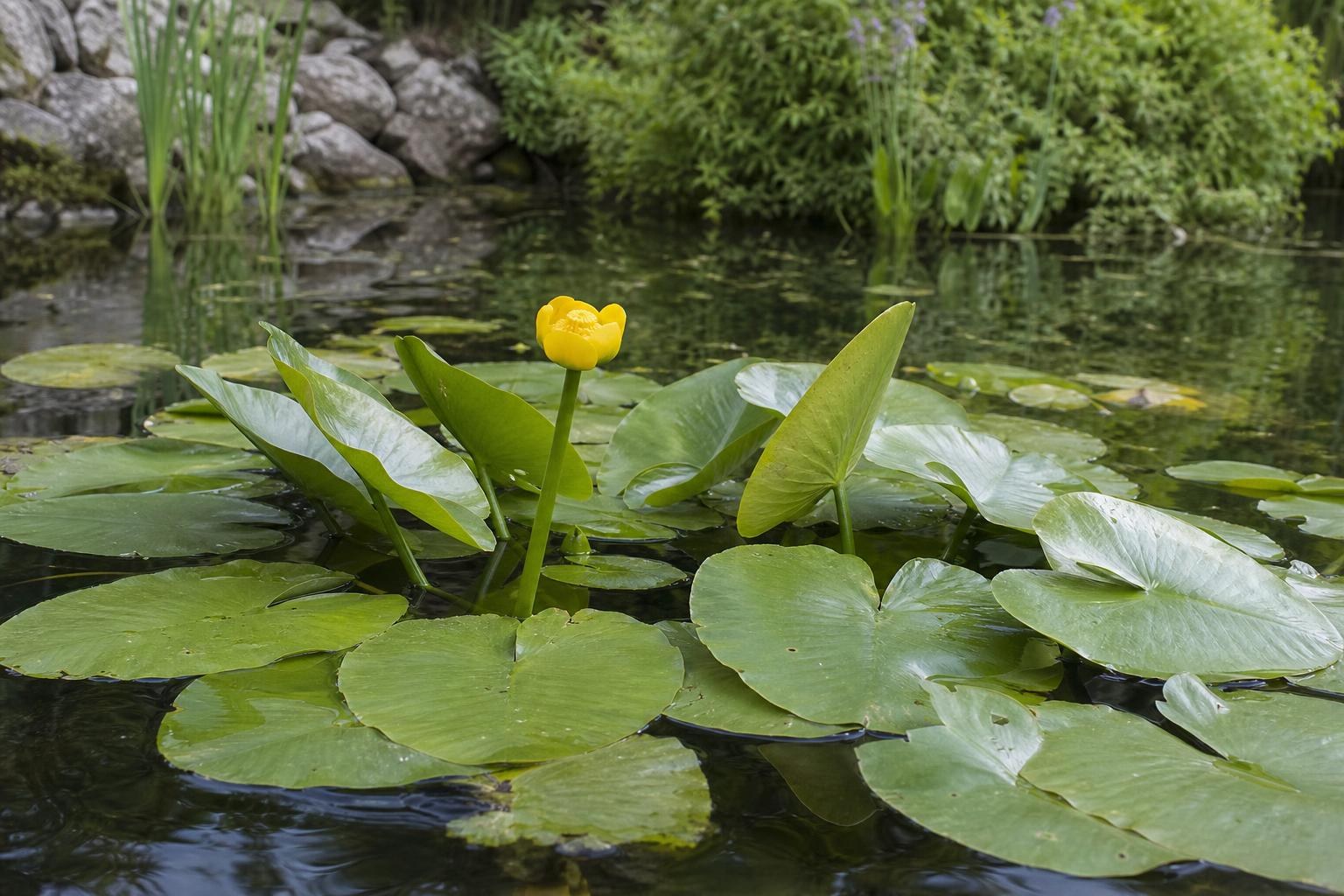
A native, rooted water-lily (Nuphar lutea) with an extensive rhizome, floating leaves and globose yellow flowers; hardy and useful for sheltering pondlife but potentially vigorous and requiring management.
PLANT PROFILE
About Yellow water lily
The yellow water lily (Nuphar lutea) is a rooted, deciduous aquatic perennial with an extensive rhizome buried in pond sediment. It produces submerged, thin ‘cabbage’-type leaves as well as larger floating leaves (up to about 40 cm across) and solitary globose yellow flowers that rise at or just above the water surface. It is widely recorded in UK ponds and treated as a native species.
For garden ponds it is commonly grown in baskets or containers using aquatic compost, with the crown positioned at the compost surface and initially covered by c. 15–25 cm of water; baskets may be lowered as the plant establishes. As a species it can occupy much deeper waters in the wild (sources note it favours roughly 100–300 cm and is reported to thrive in depths up to 200–500 cm), but garden cultivation normally follows shallower, cultivar-specific guidance.
Yellow water-lilies provide useful shelter and shading for pondlife and can help reduce algae by shading the water. However, Nuphar lutea produces extensive rhizomes and can become vigorous; RHS guidance warns it “has the potential to become a nuisance if not managed well.” For garden use, containment in baskets, regular feeding with aquatic fertilizer tablets in spring, removal of decaying leaves and spent flowers, and dividing overcrowded clumps every 4–5 years are recommended maintenance measures. Divisions are made so each section has a shoot and fibrous roots and are replanted into baskets. The plant dies back in late autumn and remains dormant over winter, resprouting in spring.
Because of its vigour and spread (RHS gives a spread to c. 100–150 cm), Nuphar lutea is generally not ideal for very small ponds unless carefully contained and closely managed. In the gov.uk and RHS materials consulted it is described as a native species and was not identified as a species subject to statutory prohibition in the gov.uk resources reviewed.
POND SUITABILITY