Marginal pond plant
Siberian iris
Iris sibirica L.
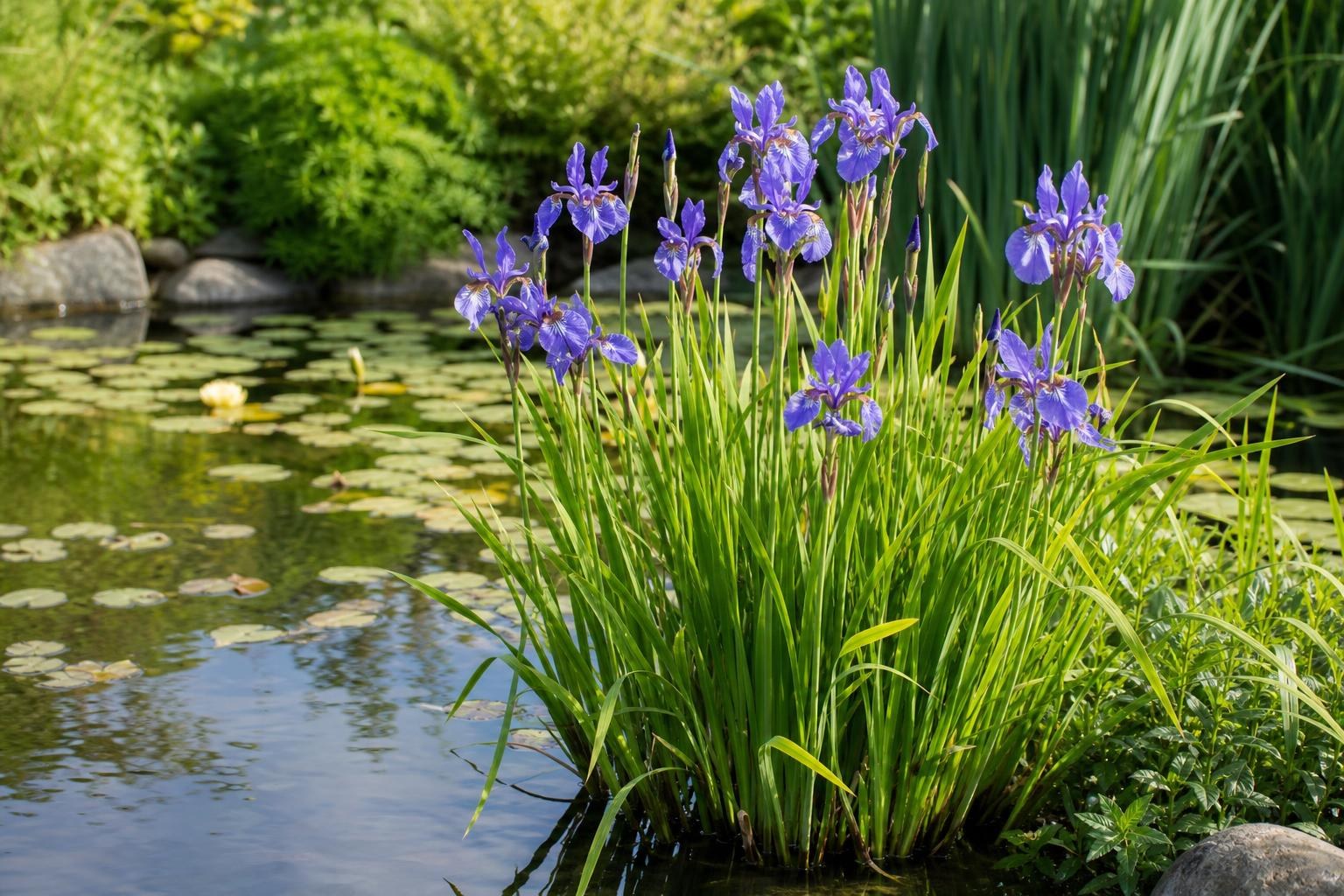
Siberian iris (Iris sibirica) is a clump-forming herbaceous perennial used as a pond marginal, recommended for very shallow water (less than 5 cm). It is hardy, easy to grow and suits full sun to partial shade.
PLANT PROFILE
About Siberian iris
Siberian iris (Iris sibirica) is a clump‑forming, herbaceous perennial that RHS lists among suitable pond marginals. It is normally treated and sold as a potted perennial and is best used at pond edges or in very shallow water rather than planted fully submerged. RHS places it in the very shallow water category (less than 5 cm), and for small pools recommends containerising marginal plants — specifically planting in 15 cm pots or baskets — so they can be lifted and re‑potted as needed.
Heights reported by RHS vary by context: the species profile gives a maximum of about 1–1.5 m, while the RHS pond/marginal table lists a typical marginal height of around 45 cm, reflecting how tall it may appear when used at a pond edge. Spread for the species is given as up to about 0.1–0.5 m. Position should be full sun to partial shade. Flowering is in late spring to early summer (RHS notes flowering in May and June).
As a marginal it provides the general wildlife and structural benefits RHS attributes to pond marginals — shelter, perching/resting sites and value to visiting insects — although the supplied sources do not list species‑specific wildlife interactions. RHS also records that Iris sibirica is not native to Britain & Ireland. It is not listed among submerged oxygenators in the sources reviewed.
Care is straightforward: RHS describes Siberian irises as easy to grow, advising division of congested clumps every 3–4 years to maintain flowering, removing dead foliage in autumn and cutting off spent flower stems after flowering. Watch for common garden pests such as slugs and snails and the potential for fungal or bacterial problems. Note: RHS pages contain inconsistent wording about rhizomes (one page says the plant does not have rhizomes and is sold in containers only, while the species profile describes it as rhizomatous and gives division-of-rhizomes guidance); follow the explicit propagation/division instructions given on the species/cultivar pages when dividing.
POND SUITABILITY