Marginal pond plant
Purple moor-grass
Molinia caerulea
A tuft-forming, native UK perennial grass that naturally occupies wet ground and pond margins; tall tussocks flower in mid to late summer and provide habitat value but can become dominant if unmanaged.
PLANT PROFILE
About Purple moor-grass
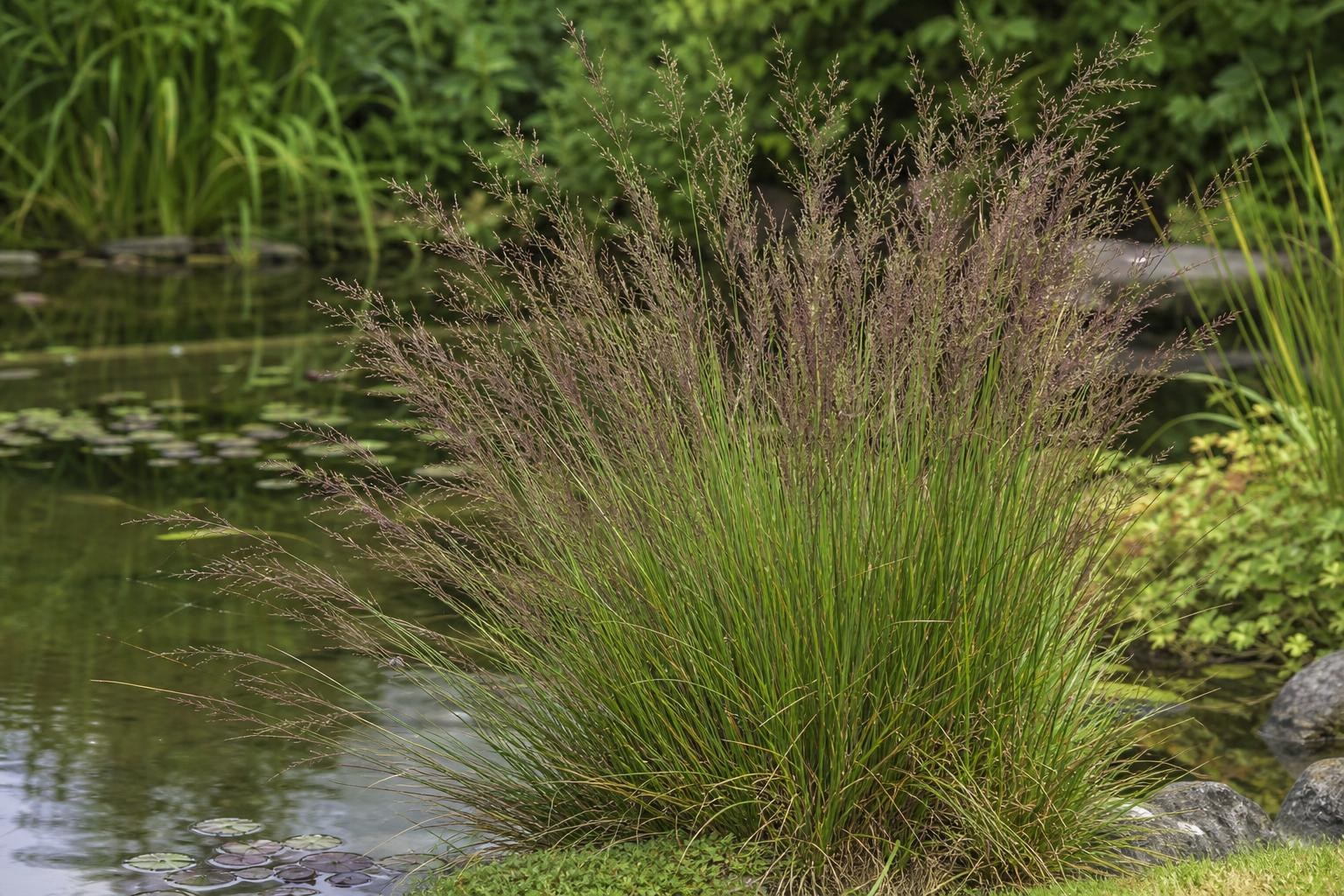
Purple moor-grass (Molinia caerulea) is a tuft-forming perennial grass commonly found on moors, bogs, fens and wet pastures and is regularly recorded at pond margins and in shallowly flooded tussocks. As a marginal/emergent, rooted grass it is not described in the supplied sources as a submerged or free‑floating oxygenator; rather it is a marsh/margin plant that can be appropriate for moist ground around garden ponds where a tussocky, structural grass is wanted.
The species can reach substantial size (the RHS species profile gives an overall height range up to c. 1.5–2.5 m) and a spread commonly reported up to around 0.5–1.0 m. It flowers in summer to early autumn (roughly July to September) and shows seasonal colour change — blue‑green in summer, tawny orange in autumn and pale in winter. It is native to the UK and has recognised wildlife value: Molinia‑dominated habitat supports a range of plants and invertebrates and can be valuable for pollinators, amphibians and other wetland species in appropriate settings.
Horticulturally, RHS guidance treats it as straightforward to grow on moist, neutral to acid soils in full sun to partial shade and records propagation by seed (sown in pots in a cold frame in spring) or by division in spring. The supplied sources do not give numeric planting depths or precise pond‑planting protocols; pond surveys and habitat reports note occurrence at pond margins and in temporary pools but do not convert that to centimetre depths. Managers should be aware that Molinia readily forms dense tussocks that can reduce floristic diversity if left unmanaged; conservation guidance therefore recommends grazing, cutting and hay removal to control dominance and explicitly advises against burning Molinia as this can perpetuate its spread. In garden use, cut back dead foliage and old flower stems before new growth in spring; the species is generally pest‑ and disease‑free.
POND SUITABILITY