Marginal pond plant
Pickerel weed
Pontederia cordata
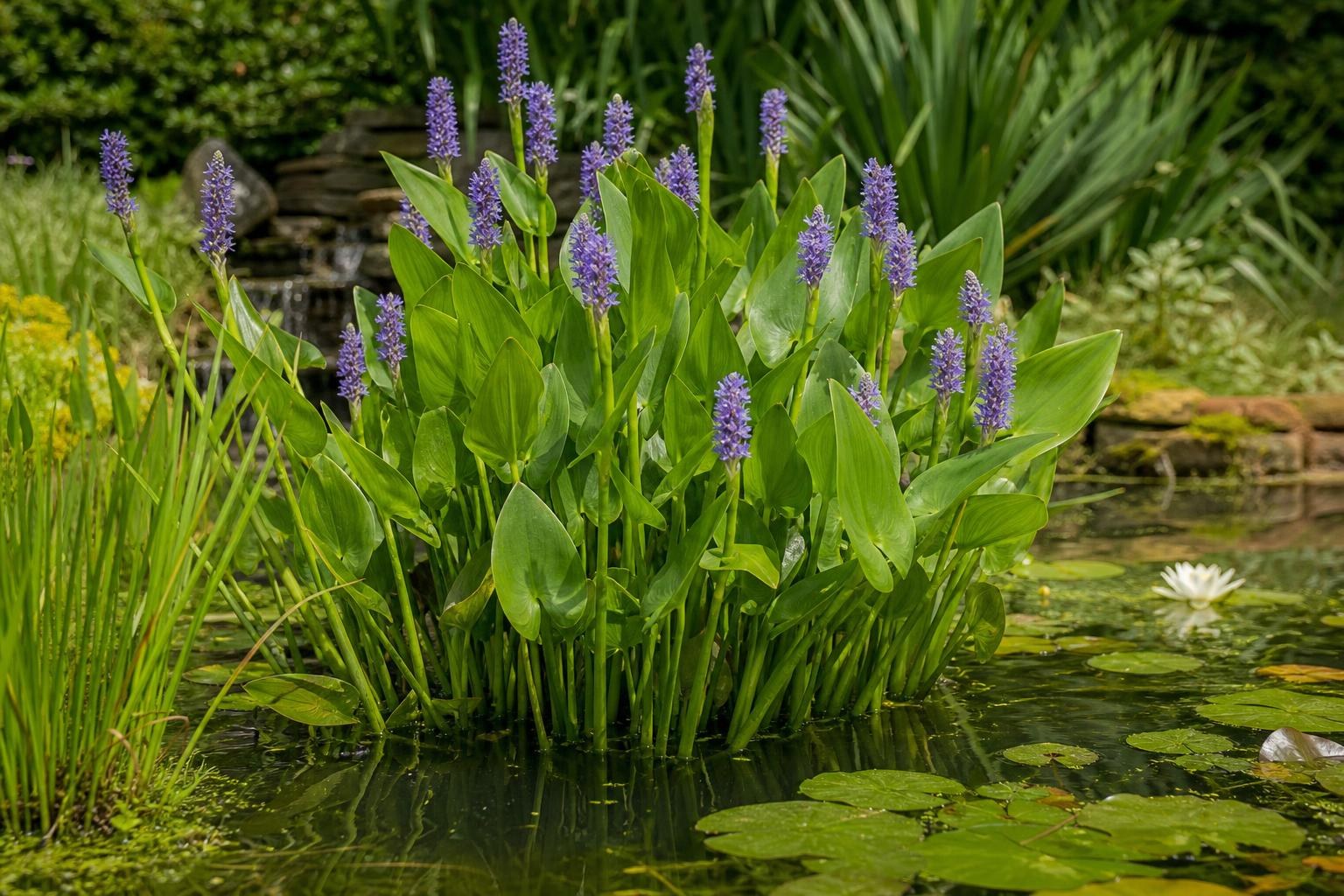
Pickerel weed (Pontederia cordata) is a clump-forming marginal aquatic perennial with showy late-summer to early-autumn flower spikes; plant in baskets of fertile loam in shallow water and manage to prevent escape into the wild.
PLANT PROFILE
About Pickerel weed
Pickerel weed (Pontederia cordata) is a clump-forming marginal emergent recommended by RHS for ponds and bog gardens. It produces erect leaves and showy flower spikes in late summer to early autumn and is typically grown in baskets or containers at the pond margin. RHS cultivation advice is to grow it in baskets of fertile loam in shallow water (10–12 cm over the basket) and in full sun. Pond-plant guidance groups Pontederia cordata as a marginal suitable for water c.5–15 cm deep, and for small pools RHS recommends containerising marginals and repotting when overcrowded.
There is some variation in reported height: an RHS plant profile gives a maximum of 1–1.5 m, while an RHS pond-plants table lists a typical height of 45–60 cm above the water surface; the RHS sources do not reconcile this difference. Spread is given by RHS as up to 0.5–1 m. The plant is deciduous: foliage dies back in autumn/winter and re-shoots in spring. RHS recommends cutting back after flowering and dividing clumps in spring to propagate and control vigour; seed propagation from ripe seed is also noted.
Pontederia cordata is recorded by the Environment Agency as a non-native hydrophyte established in the wild in the UK; RHS also notes it is not native to Britain and Ireland. The supplied gov.uk guidance on invasive non-native plant rules explains the legal framework for listed species, but the specific gov.uk pages reviewed did not themselves list Pontederia cordata as a statutory banned species. Given its non-native status and records of establishment in the wild, follow biosecurity precautions: contain plants in baskets, dispose of plant material responsibly and avoid releasing fragments or plants into wild waterbodies. RHS notes the plant is generally pest- and disease-free when grown as recommended.
POND SUITABILITY