Marginal pond plant
Marsh thistle
Cirsium palustre
A native biennial marsh-edge thistle valued by pollinators and suited to damp pond margins and drawdown zones rather than open water.
PLANT PROFILE
About Marsh thistle
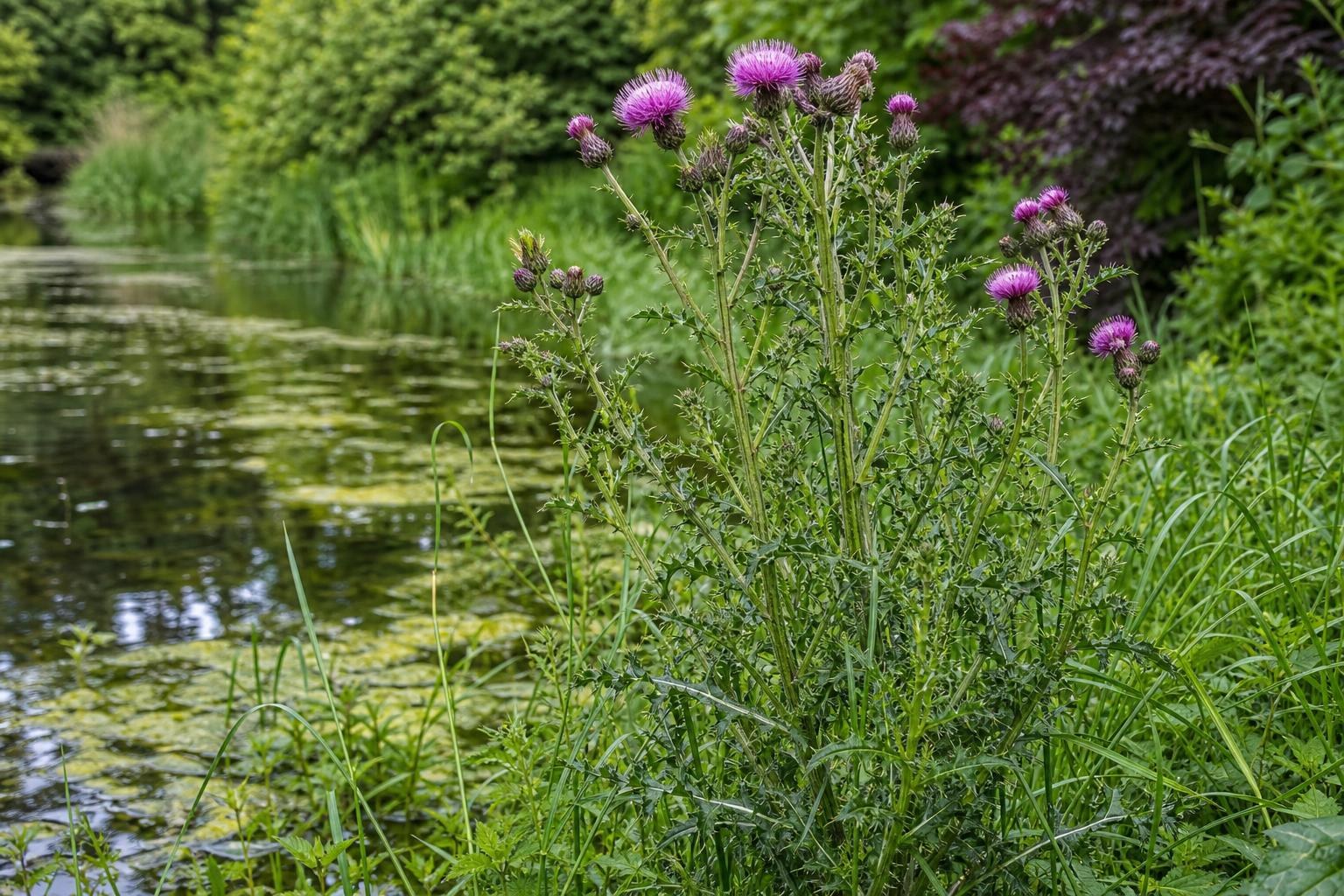
Marsh thistle (Cirsium palustre) is a native UK biennial commonly found in marshy ground, wet grassland and at pond margins. It typically forms a basal rosette in its first year and sends up spiny, erect flowering stems in the second year, producing clusters of purple flower heads in summer before the stems die back and leave seed. The species is recorded in Freshwater Habitats/SEPA pond guidance and surveys as an emergent/marginal plant for drawdown zones and moist soil, and the RHS lists it as a clump-forming biennial suited to damp ground rather than as a submerged or free-floating aquatic.
For garden ponds, marsh thistle should be used only at the edge in damp soil or the drawdown zone and not planted into open water; SEPA/Freshwater Habitats guidance recommends planting marginal species in small mixed clumps at the water’s edge or allowing natural colonisation by seed in countryside ponds. Propagation is by seed, and using locally sourced native stock or encouraging natural recruitment is advised for conservation-sensitive sites. Marsh thistle is valued by pollinators and is recorded on Plantlife reserves and in RHS wildlife lists as a good nectar source for insects.
Maintenance is generally straightforward: RHS notes it is generally pest- and disease-free and requires no pruning; SEPA guidance recommends retaining a mosaic of marginal vegetation and avoiding wholesale clearance of pond edges. Expect flowering stems to die back after seed set with the plant persisting as a rosette and by seed over winter. The supplied sources do not give precise planting or suitable water-depth measurements in centimetres, so plant only where soil stays damp at the pond margin and manage seed and density where necessary to prevent extensive colonisation. GOV.UK guidance on injurious weeds does not list marsh thistle as a prescribed injurious species under the Weeds Act 1959.
POND SUITABILITY