Marginal pond plant
Marsh cinquefoil
Potentilla palustris
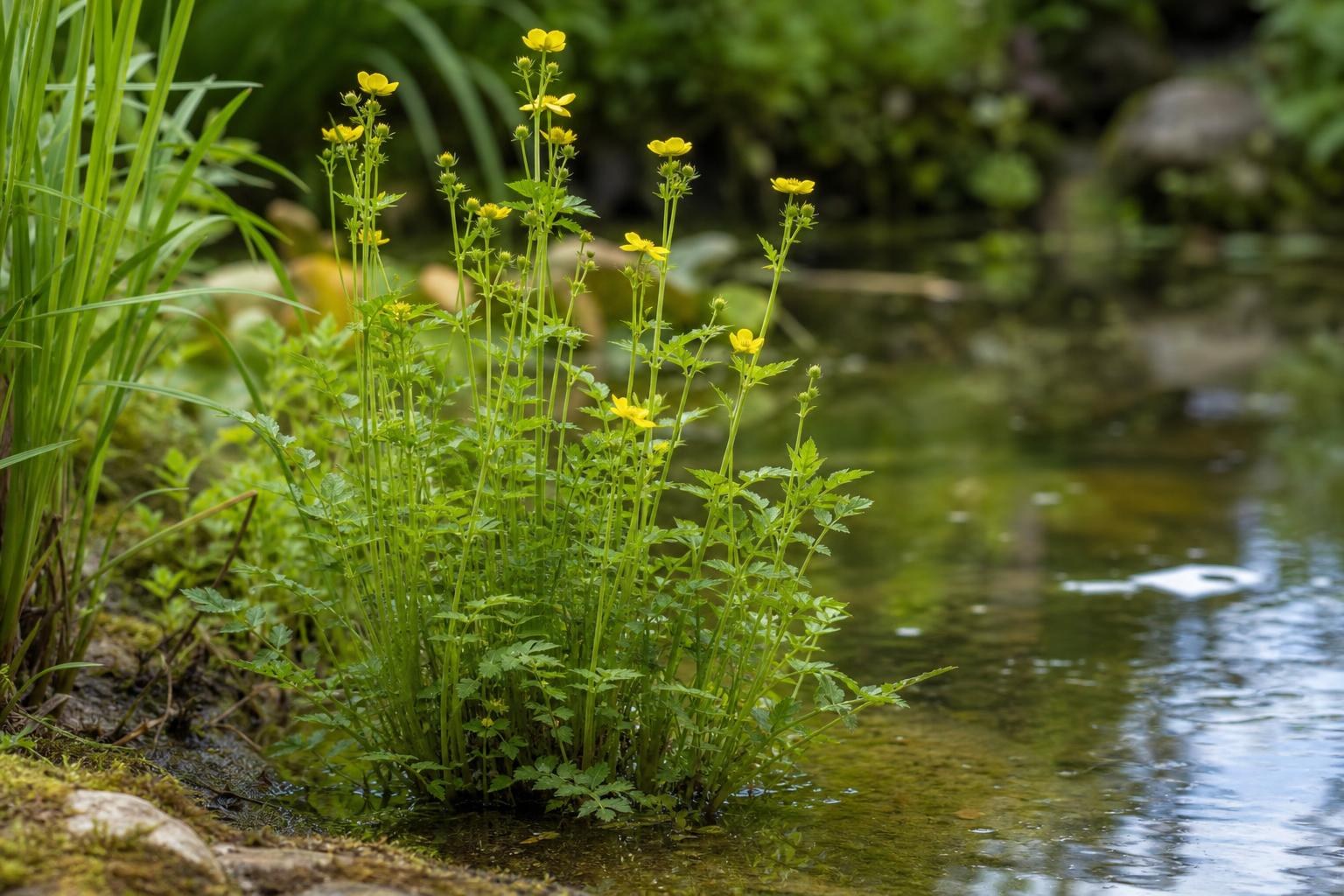
A rhizomatous, clump-forming marginal perennial for pond edges, Marsh cinquefoil is suited to permanently wet soil and is planted with the crown in shallow water (2–10 cm). It flowers in early summer and has recognised wildlife value in UK wetlands.
PLANT PROFILE
About Marsh cinquefoil
Marsh cinquefoil (Potentilla palustris) is a woody-based, rhizomatous perennial that forms clumps of upright stems and is recommended as a marginal planting for pond edges and damp banks. Supplied-source guidance (Freshwater Habitats Trust and RHS) recommends planting marginals so the top of the soil or crown sits in 2–10 cm of water, either on a marginal shelf or in containers/aquatic baskets. RHS cultivation notes describe the species as suited to permanently wet, neutral to alkaline soils and as tolerant of heavier soils such as clay or loam.
RHS gives a maximum height to about 50 cm and a potential spread up to 1 m, so allow space for clump expansion or use containerisation to control cover where necessary. Flowers appear in early summer (as described in the RHS profile). The species is deciduous, with above-ground foliage dying back in winter, and carries a hardiness rating of H7 in RHS guidance.
Freshwater Habitats Trust and RHS list Marsh cinquefoil among native marginal species beneficial for wildlife, and GOV.UK and Plantlife include it in native species lists and indicator-species contexts; these sources therefore support its wildlife value in pond and wetland plantings. Propagation is by seed or by division in autumn or spring, as noted by RHS.
Maintenance is straightforward: generally pest-free and needing little pruning, while rhizomatous growth can be controlled by periodic division or container planting. Pond-management guidance recommends thinning/dividing when required, composting removed material and not removing more than about 25% cover at once if wildlife habitat is the objective. RHS notes possible susceptibility to honey fungus, though the plant is otherwise low-maintenance. The supplied sources do not describe Marsh cinquefoil as a submerged oxygenating species and do not establish explicit suitability specifically for small ponds; they do, however, support its use as a marginal planting in shallow water (2–10 cm).
POND SUITABILITY