Marginal pond plant
Japanese water iris
Iris ensata
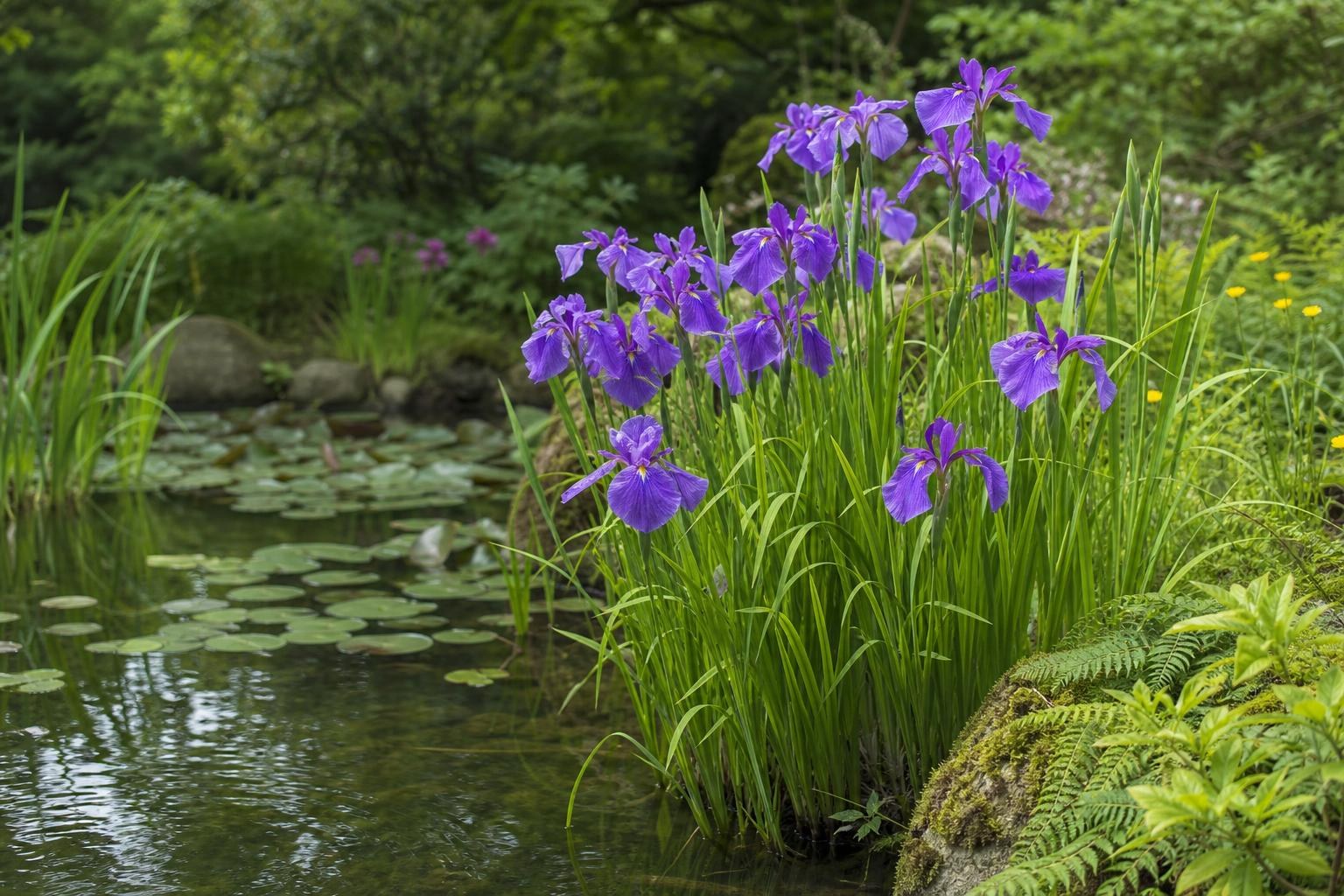
A rhizomatous, clump-forming marginal iris for pond edges, Iris ensata thrives in humus-rich, moist soil with crowns kept out of standing water. Plant rhizomes c. 7.5 cm deep and site in full sun to partial shade.
PLANT PROFILE
About Japanese water iris
Japanese water iris (Iris ensata) is a rhizomatous, clump-forming perennial prized for pond-edge planting. RHS guidance places it firmly at margins and stream-sides rather than as a submerged plant: crowns should not be left underwater, and plants are best rooted in humus-rich, neutral to acid soil at the pond edge. Freshwater Habitats Trust marginal-band guidance (applied to pond-edge species such as I. ensata) recommends planting in the marginal band (roughly 2–10 cm water over the edge substrate) while RHS cultivar pages give explicit rhizome planting depth instructions (plant rhizomes about 7.5 cm deep).
Position in full sun to partial shade for best flowering; flowering is cited as late spring to early summer (May–June). The plant is described by RHS as completely hardy and easy to grow, making it suitable for typical UK garden ponds and for city or courtyard pond margins where space allows. Mature height is commonly given in the 50–100 cm range and the clump-forming habit typically produces a modest spread (cultivar lists commonly show up to c. 0.1–0.5 m).
Practical care notes from the supplied sources: avoid submerging crowns or prolonged winter waterlogging, divide congested clumps every 3–4 years (division is the recommended propagation method, best performed midsummer to early autumn), remove dead foliage and cut down old flower stems after flowering, and be aware of slug/snail pressure and typical iris pests/diseases. Iris ensata is not listed in RHS/FHT oxygenator lists and should not be treated as a submerged oxygenating plant. The species is of Japanese origin and is not indicated in the supplied material as native to the UK.
POND SUITABILITY