Oxygenating pond plant
Hornwort
Ceratophyllum demersum
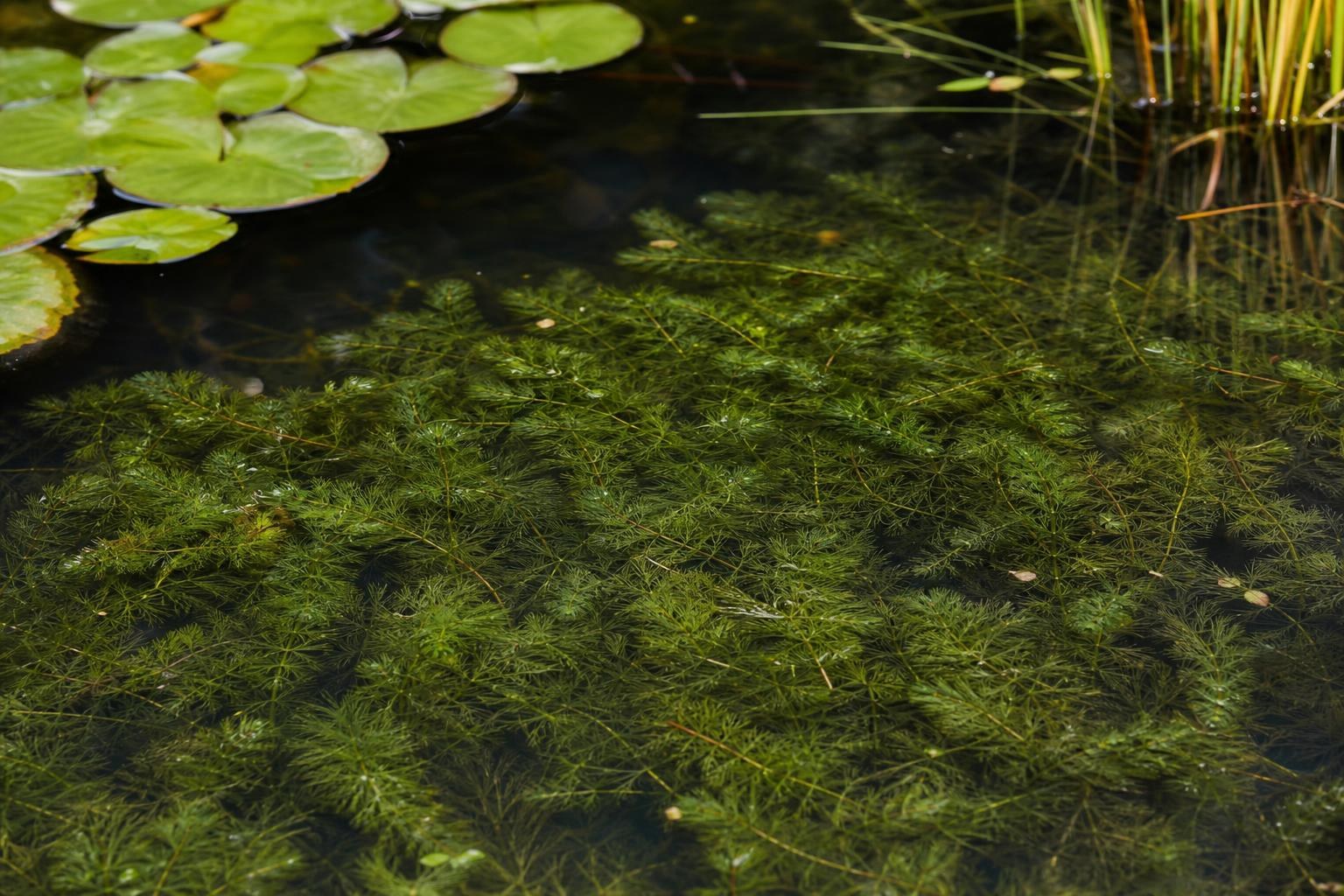
Hornwort (Ceratophyllum demersum) is a native, free‑floating submerged oxygenator that provides underwater cover for fish, tadpoles and invertebrates. It is easy to establish from stem cuttings but can form dense mats that need periodic thinning.
PLANT PROFILE
About Hornwort
Hornwort (Ceratophyllum demersum) is a wholly submerged, mat-forming perennial widely used in UK garden and wildlife ponds. It is typically free‑floating within the water column and does not root into substrate, forming bushy, whorled tufts that provide valuable underwater cover for tadpoles, fish fry and invertebrates. RHS lists it as an effective oxygenator and notes it also acts as a filter to help keep ponds clear.
Cultivation is straightforward: plants are normally introduced as stem cuttings which are allowed to float and establish; suppliers and guidance do not give a planting/container depth because the species is not rooted. Sources differ slightly on maximum water depth: RHS states growth in water up to 150 cm deep, while a DEFRA/Environment Agency technical guide notes it is usually found to about 1 m (though sometimes deeper). A minimum suitable water depth is not specified in the consulted guidance.
Hornwort is generally easy to grow and tolerant of a wide range of conditions, including eutrophic water, and is pest- and disease-free according to RHS. However, it can be vigorous and form dense mats; periodic removal or thinning is commonly used to control excessive growth. Increased flow can dislodge free‑floating stands, which may reduce local abundance but can move fragments downstream. Winter dieback is normal: the plant dies back and survives via modified stem buds/turions in the sediment which re‑establish in spring.
Although native to Great Britain and Ireland, local conservation assessments (for example in Wales) note population-level concerns in some areas, so check site-specific guidance before translocating plants into protected or conservation areas. GOV.UK materials consulted did not list Ceratophyllum demersum on Schedule 9 invasive species lists for England & Wales; nevertheless, good biosecurity is advised—avoid releasing fragments into the wild and dispose of removed material responsibly.
POND SUITABILITY