Marginal pond plant
Astilbe 'Deutschland'
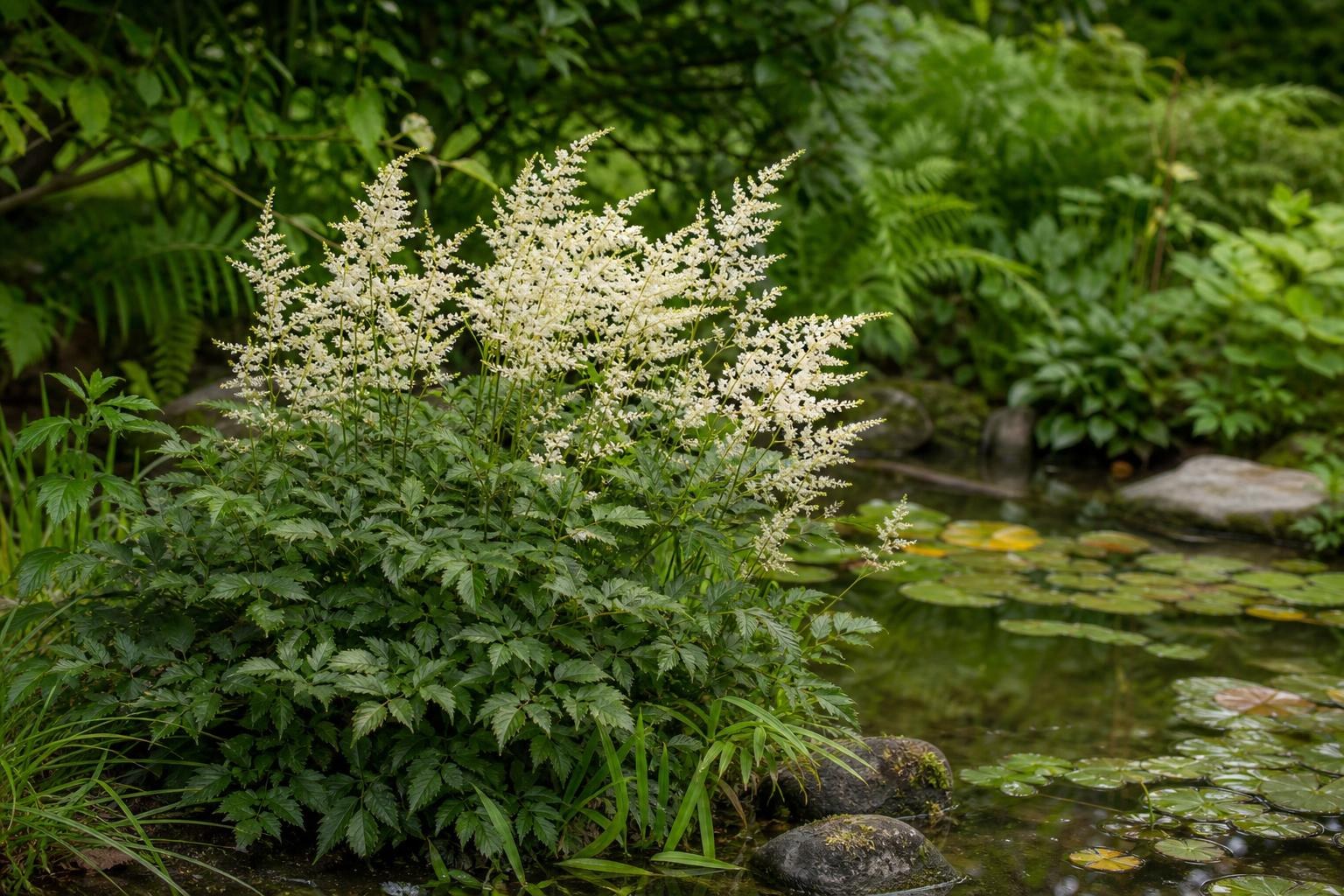
Astilbe 'Deutschland' (Astilbe japonica hybrid)
A clump-forming, rhizomatous perennial suited to moist, shady pond margins and containers; produces open, slightly arching sprays of white flowers in late spring/early summer.
PLANT PROFILE
About Astilbe 'Deutschland'
Astilbe 'Deutschland' is a clump-forming, rhizomatous herbaceous perennial recommended for waterside and boggy soils rather than as a submerged aquatic. RHS lists this cultivar as “good for waterside planting” and notes it thrives in damp, shady sites and in containers, making it appropriate for planting at the pond edge or in pond-margin pots. Plants produce open, slightly arching sprays of white flowers appearing in late spring or early summer and typically form upright clumps 0.5–1.0 m tall with a spread of about 0.1–0.5 m.
For pond use, treat Astilbe 'Deutschland' as a marginal/emergent perennial: position it in consistently moist, rich soil at the water’s edge or in a container on the pond bank so that part of the plant remains above water. Freshwater Habitats Trust guidance for marginal planting (for example using a ‘V’ trench, pushing into sediment or planting in turves) applies to pond-edge perennials; these methods help establish emergent plants and encourage them to grow up the bank and provide marginal cover. RHS cultivation notes emphasise that astilbes dislike drought and hot sun, preferring dappled or light shade and moisture-retentive, organic-rich soils.
The cultivar is fully hardy (RHS H7) and deciduous: foliage dies back over winter to the crown/roots, and old brown flower-heads can remain attractive in autumn. Propagation is by division in late winter or early spring (pot divisions under glass and plant out in late spring). Maintenance advice from RHS includes cutting back after flowering, keeping soil consistently moist, and monitoring for pests and diseases such as vine weevil and powdery mildew. The supplied sources do not list this cultivar as an invasive or legally restricted species on the GOV.UK lists consulted for England & Wales, and they do not provide numeric planting or water-depth measurements for this cultivar.
POND SUITABILITY