POND FISH GUIDE
Black Moor
Carassius auratus
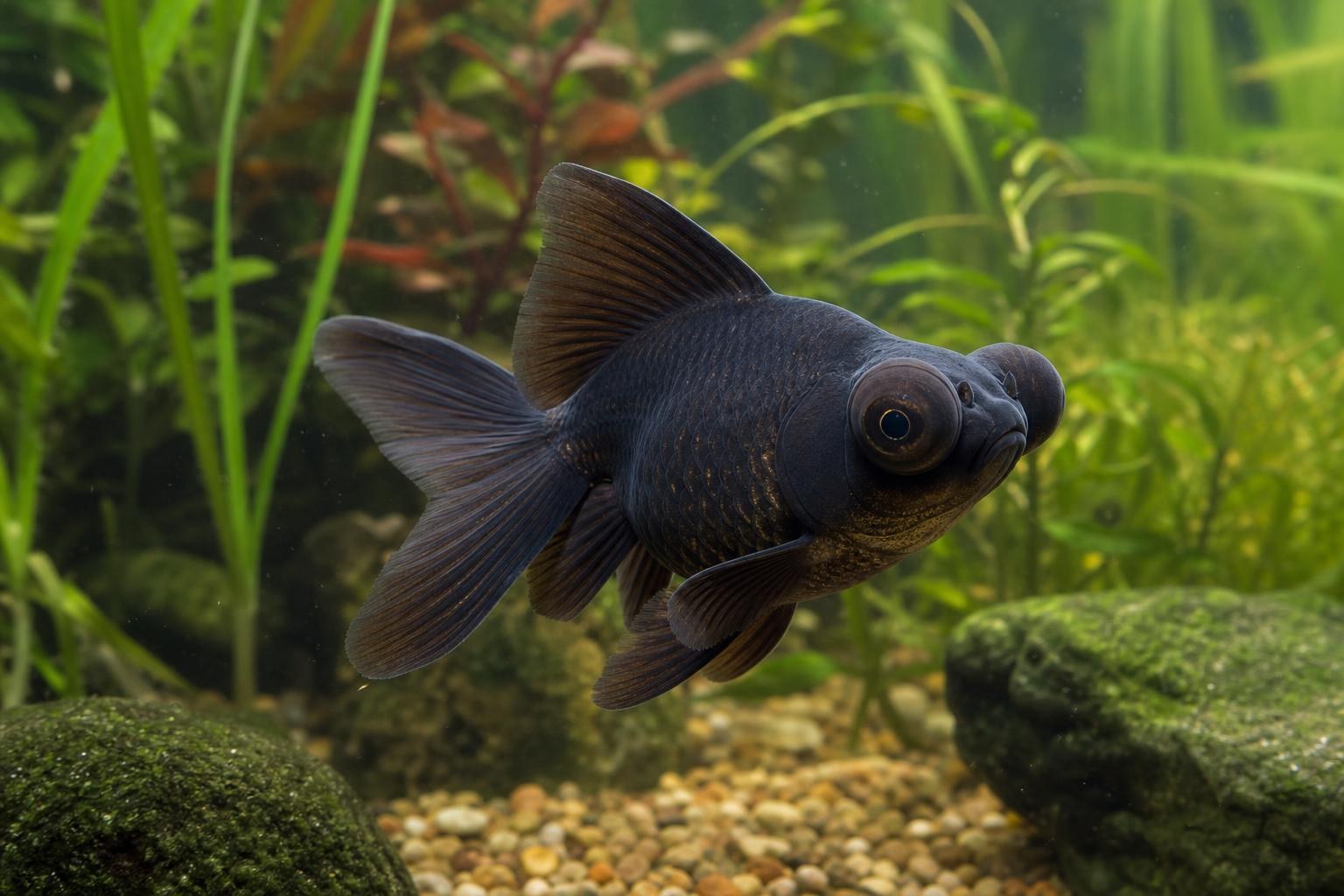
A telescope‑eyed fancy goldfish variety of Carassius auratus. Black Moors are slow‑swimming, omnivorous and cold‑tolerant but need good filtration, careful feeding and adequate pond depth. They suit dedicated ornamental ponds rather than wildlife ponds.
At a glance
- Maximum length
- Up to 25 cm
- Minimum pond depth
- 45 cm
- Temperature range
- 4–28°C
- Care level
- moderate
- Suitable for small ponds
- No
- Suitable for wildlife ponds
- No
About Black Moor
Black Moors are a domesticated “fancy” variety of goldfish (Carassius auratus) known for their black colour and protruding telescope eyes. They are not a wild species but a selectively bred hobby variety, and although cold‑tolerant they are more delicate than common/single‑tailed goldfish. Adults are commonly reported to reach around 20–25 cm. For UK pond owners the practical priorities are stable water quality, good filtration and adequate oxygenation. Fancy goldfish produce a lot of waste, so an efficient filter and regular water changes in smaller systems are important. Use sinking or slow‑sinking goldfish pellets/granules to reduce gulping air and swim‑bladder problems; supplement with frozen or live foods (bloodworm, daphnia, mysis) and blanched vegetables (lettuce, peas) for fibre. Avoid overfeeding. Black Moors are peaceful and sociable with other fancy goldfish but are slow swimmers; avoid housing them with faster single‑tailed goldfish that will outcompete them at feeding. They can uproot or eat some plants, so choose robust planting and smooth decor to protect delicate fins and eyes. Temperature guidance in hobby sources varies (rough pond tolerance cited from about 4 °C up to around 25–28 °C), and OATA suggests an optimal range of roughly 15–23 °C for fancy types. OATA recommends pond depths of about 45–60 cm as a practical minimum for fish ponds to provide overwintering refuge; small shallow wildlife ponds are not appropriate for ornamental goldfish. Legal and biosecurity notes: goldfish are a long‑established non‑native ornamental species in the UK and are exempt from ILFA licensing for keeping, but you must not release fish into wild waterbodies without appropriate permission. Ornamental fish can carry notifiable diseases; follow GOV.UK and Fish Health Inspectorate guidance and never release unwanted fish into the wild.
Diet
Omnivore: sinking/slow‑sinking goldfish pellets or granules; supplemented with frozen/live foods (bloodworm, daphnia, Mysis) and blanched vegetables (lettuce, peas) for fibre.
Temperament
Generally peaceful and sociable; slow swimmer — may be outcompeted by faster single‑tailed goldfish.
Compatibility
Best kept with other fancy goldfish varieties. Avoid mixing with fast, single‑tailed common goldfish due to competition at feeding. Do not add to wildlife ponds — they can eat amphibian larvae, uproot plants and alter pond ecology.
Care notes
Provide strong mechanical and biological filtration, good aeration (spray bars/air pumps), and regular water testing (ammonia/nitrite zero; control nitrates). Use smooth décor to protect eyes/fins. Feed sinking, fibre‑rich diets and avoid overfeeding to reduce swim‑bladder issues. For tanks, OATA recommends at least 100 L per adult goldfish; for outdoor ponds aim for larger volumes and at least 45–60 cm depth or move fish indoors if pond is shallow and at risk of freezing. Follow biosecurity rules — do not release ornamental fish into the wild and be aware of notifiable diseases.